
New Kia Niro Lineup Guide for NYC Buyers
You’re standing in a Queens showroom after a test drive, looking at three Niro versions and trying to answer one practical question, which one fits New York life. That’s the right question to ask. In Manhattan, Brooklyn, Queens, and the Bronx, the car that looks best on paper isn’t always the one that works best in a garage, on a bridge, or outside a walk-up apartment.
The new Kia Niro family makes that choice easier because the lineup is built around powertrain, not body style. Kia sells the Niro Hybrid, Niro Plug-in Hybrid, and Niro EV, and they all share the same crossover shape and interior layout, so you’re really deciding how you want to drive and charge. For NYC buyers, that matters more than chrome, wheel design, or a brochure term, because parking, charging access, and commute length tend to decide ownership satisfaction faster than spec-sheet headlines.
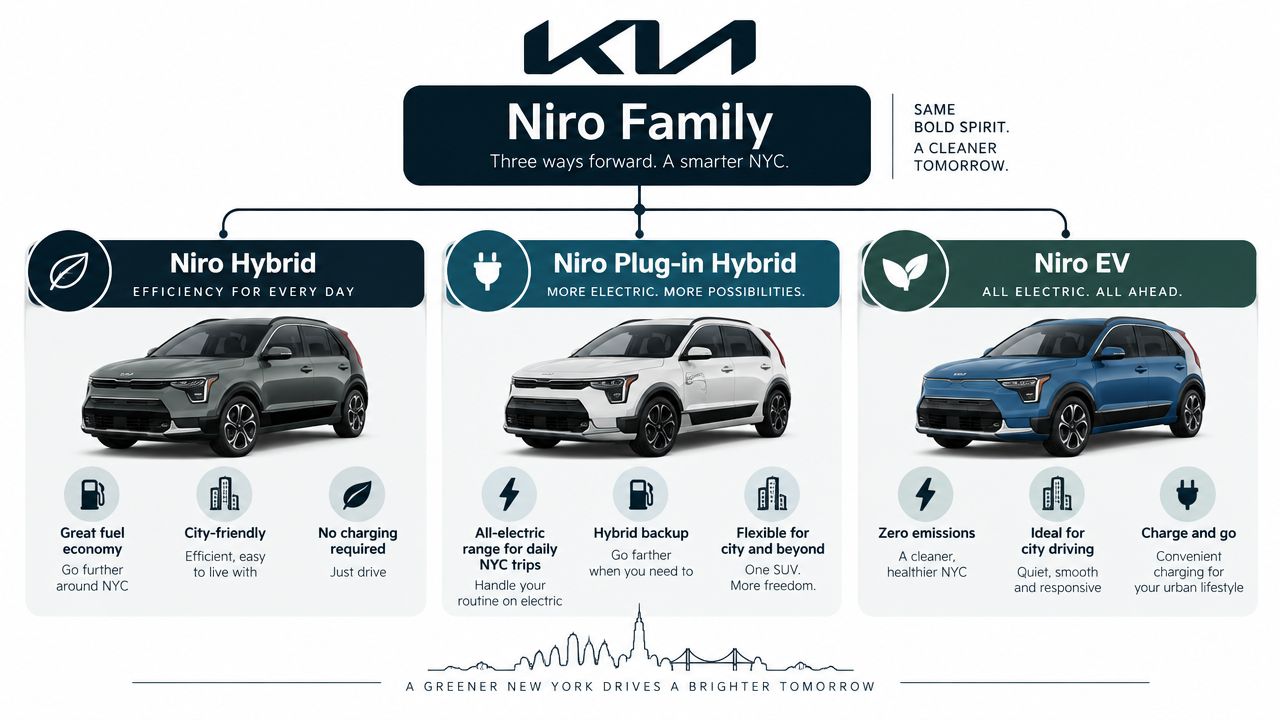
Table of Contents
- Meet the New Kia Niro Lineup
- How the Niro EV, Hybrid, and PHEV Differ
- Range, Efficiency, and Charging Compared
- A Typical Week With a Niro in NYC
- Trim Levels and Key Features
- NYC Ownership Considerations
- How the Niro Performs Beyond the City
- Choosing the Right Niro for Your Drive
Meet the New Kia Niro Lineup
A good way to think about the new Kia Niro is this, it’s one shape with three very different answers to daily driving. One buyer wants to stop at the pump as little as possible, another wants to plug in when it’s convenient, and a third wants to skip gasoline altogether. The Niro family lets you choose that answer without changing the car into something bigger, taller, or harder to park.
For New York City shoppers, that simplicity is useful. A subcompact crossover footprint is easier to live with in tight Manhattan garages, narrow Brooklyn side streets, and Queens lots where every inch matters. If you’ve ever folded mirrors in a garage or made three passes to line up with a curb spot, you already understand why size matters before horsepower does.
The other big advantage is that the Niro lineup keeps the cabin logic familiar across the family. You don’t need to relearn how the car is laid out just because you move from hybrid to EV. That makes it easier for first-time electrified buyers to focus on the one thing that changes day to day, fuel use, charging, and how the car behaves in traffic.
A Kia warranty also matters more in a city where many owners put serious miles on the odometer during commuting, school runs, and weekend cross-borough trips. The coverage gives the lineup a practical appeal for people who want predictability, not just a lower fuel bill.
Practical rule: In NYC, start with your parking and charging situation first. Powertrain comes second, because that’s the part of the decision that changes how the car fits your life.
The rest of the guide breaks the family down in plain language, then matches each version to real city routines, highway use, and ownership trade-offs. If you’re comparing the Niro against other compact crossovers, that’s the right way to shop it.
How the Niro EV, Hybrid, and PHEV Differ
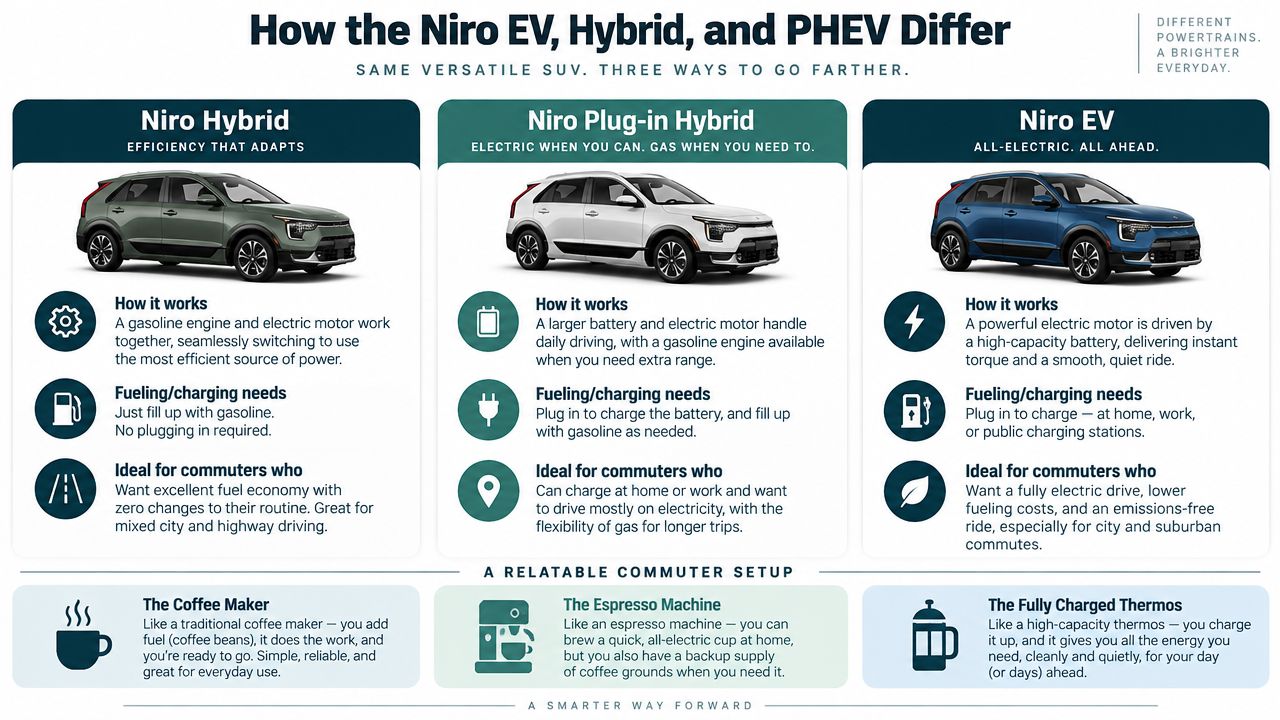
The easiest way to sort the lineup is to compare it to three different commuting styles. The Niro Hybrid is like the person who walks, rides, and takes the train when it makes sense. The Niro Plug-in Hybrid is the rider who has a subway card and a bike, so they can choose either one. The Niro EV is the buyer who decided gas stations aren’t part of the plan anymore.
The hybrid never needs to be plugged in. It uses a gasoline engine with electric assist, so it behaves like a traditional car in the sense that you fill it up and drive away. The PHEV adds a larger battery and a charging port, which gives you electric-only driving for short daily trips, then gasoline for longer stretches. The EV removes the engine completely and runs on battery power all the time.
What stays familiar across the family
Even though the energy source changes, the driver experience stays easier to learn than many first-time buyers expect. The Niro lineup keeps a similar crossover driving position, a familiar control layout, and the same basic “small SUV” feel in traffic. That makes it less intimidating if you’re moving from a gas compact to something electrified for the first time.
Here’s the key point for NYC shoppers. The hybrid is the simplest if you don’t want to think about charging. The PHEV works best if you can plug in sometimes but don’t want to depend on public charging every day. The EV fits buyers who can charge at home or at work and want the cleanest, quietest daily commute.
Shared driving feel, different energy strategy
A few pieces carry across the range, which helps the family feel coherent. Kia gives these models a similar driving personality, so the choice is how the car gets its energy, not whether the controls feel foreign. That’s helpful if one spouse, parent, or partner is nervous about switching to electrified driving.
The best way to think about the Niro family is not “which one is fastest,” but “which one fits my charging habits and my weekly mileage.”
That framing keeps buyers from overcomplicating the decision. In a city like New York, the winner is usually the version that matches your parking and charging reality, not the one with the most dramatic spec line.
Range, Efficiency, and Charging Compared
A Niro buyer in New York is usually weighing a very practical question, not a spec-sheet one. Can this car handle a Bronx commute, a Queens garage, a Manhattan curbside parking pattern, or a weekend run that starts with a bridge toll and ends with a search for charging? The answer depends on how each powertrain handles energy, not just how far it can travel in ideal testing.
The Niro EV is the clearest fit for drivers who can charge regularly. Recent model years carry an EPA-estimated 253-mile range from a 64.8-kWh battery, with EPA efficiency rated at 113 MPGe combined, 126 MPGe city, and 101 MPGe highway (Car and Driver). Kia’s European specification sheet also lists a 64.8 kWh usable battery, a WLTP range of 463 km, and DC charging up to 94 kW, with roughly 45 minutes to reach 80% on a 100 kW DC charger. For city driving, that means the EV can fit a weekday rhythm well, especially if you have home or workplace charging.
The Niro Hybrid is the easier fit for drivers who want to keep fueling simple. It uses a 1.6-liter four-cylinder engine with two electric motors for 139 hp and 195 lb-ft, and EPA economy of 53/45/49 mpg city/highway/combined (Car and Driver). Expert testing also records about 8.8 seconds to 60 mph and a highway range around 430 miles to more than 500 miles, depending on trim and conditions. That makes the hybrid a practical choice for drivers who spend a lot of time in traffic, but do not want their day shaped by charging access.
The Niro PHEV sits between those two. It can run on electricity for short errands, then switch to gas once the battery is used up. For NYC life, that matters because a short grocery trip, a school run, or a cross-borough errand may never need gas, while longer days still have backup built in.
| Spec | Niro Hybrid | Niro PHEV | Niro EV |
|---|---|---|---|
| Energy source | Gasoline engine with electric assist | Plug-in battery plus gasoline backup | Battery electric only |
| Driving range focus | Long tank-to-tank use | Short electric trips, gas for longer drives | All-electric commuting and regional trips |
| EPA or published efficiency | 53/45/49 mpg city/highway/combined (Car and Driver) | Electric-only and combined efficiency vary by use, with the powertrain designed for short plugged-in trips first | 113 MPGe combined, 126 city, 101 highway (Car and Driver) |
| Battery | Small hybrid battery, not plug-in | Larger plug-in battery | 64.8 kWh usable battery (Kia specifications) |
| Charging | Regenerative charging only | Plug-in charging and gasoline | AC home charging, DC fast charging up to 94 kW in published European specs (Kia specifications) |
Cold weather puts more strain on the EV because battery range changes more with temperature and cabin heat use. In a New York winter, that means the EV asks more planning from the driver than the hybrid or PHEV, even though it offers the cleanest daily commute when charging is easy.
A Typical Week With a Niro in NYC
A Niro makes the most sense when you stop thinking in single trips and start thinking in routines. A lot of NYC ownership is repetitive, school drop-offs, office commutes, grocery runs, and a weekend escape that starts after you’ve already sat through traffic on the FDR Drive. The right powertrain changes how annoying that rhythm feels.
The EV week
A Niro EV can handle a Queens-to-Midtown commute with little drama if you have a place to charge overnight. In stop-and-go traffic, the lack of gasoline stops feels especially valuable. If you’re crawling through Lincoln Tunnel traffic, you’re still consuming battery energy, but you’re not burning fuel while everyone else waits.
By midweek, the question becomes where the car sleeps. A driver with an off-street garage in Astoria can plug in overnight and wake up ready to go again. That pattern works because the EV rewards predictability, not because it needs a perfect schedule.
The hybrid week
The Niro Hybrid is the flexible one. It can cover a full work week through the boroughs on gasoline and electric assist, then stop for fuel when the tank says so. For a driver bouncing between the BQE, the Cross Island Parkway, and local streets, that simplicity can feel easier than managing charge levels.
If your week changes by the hour, the hybrid usually asks the least from you.
The downside is that you’re always using fuel, even if efficiently. That’s why some buyers view the hybrid as the “no homework” version of the Niro family.
The PHEV week
The Niro PHEV is the most interesting middle case. A driver can plug in at a Whitestone municipal lot, run school errands in Bayside on electricity, then switch back to gasoline for a weekend run toward the Palisades. That’s a good fit when your weekday mileage is short and your weekend plans aren’t.
This version is easiest to like if you can keep a charging habit. Without it, the PHEV becomes a heavier hybrid with extra hardware that you’re not fully using. With it, the car feels much closer to an electric commuter on most days.
Trim Levels and Key Features
Once you’ve chosen the powertrain, trim choice becomes a question of comfort and convenience. The important thing is not to let the trim discussion hide the fact that some features belong only to certain powertrains. A buyer should always confirm that the trim and powertrain pairing exists before getting too attached to a build.
What the cabin features are doing for you
The Niro family offers the kind of features city drivers notice in daily use. An 8-inch touchscreen is enough for basic commuting, while an available 10.25-inch touchscreen gives you a more expansive interface for maps and media. Wireless Apple CarPlay and Android Auto matter because you’re often hopping in and out of the car for short trips, and a cable-free setup keeps the cabin tidier.
Upper trims add more comfort-focused gear. Ventilated front seats help in summer traffic. Harman Kardon audio makes longer drives feel less tiring. The Smart Power Tailgate helps when your hands are full after grocery shopping or airport pickups.
The EV line also gets specific equipment that buyers should watch for closely. Vehicle-to-Load capability and a heat pump are tied to certain EV trims, and those features matter in a city where winter efficiency and practical power use can both matter. The hybrid’s upper grades lean more into upgraded materials and convenience, while the PHEV and EV each bring their own equipment priorities.
Buyer note: Don’t compare trims across the lineup without checking the matching powertrain. Some equipment is trim-specific, but some of the most important hardware is powertrain-specific.
| Trim | Powertrain Availability | Notable Standard Features | Key Available Upgrades |
|---|---|---|---|
| Base grades | Hybrid, PHEV, EV depending on market configuration | Core infotainment, crossover practicality, driver-focused layout | Larger touchscreen, connectivity upgrades |
| Mid grades | Hybrid, PHEV, EV | Wireless phone integration, more comfort features, added driver assistance | Better audio, more convenience tech |
| Upper grades | Hybrid, PHEV, EV in selected trims | Premium materials, advanced comfort items, stronger feature mix | Harman Kardon audio, ventilated front seats, Smart Power Tailgate |
| EV-specific trims | EV only | Battery-focused equipment and efficiency-minded hardware | Vehicle-to-Load, heat pump |
For a Queens or Bronx buyer, the practical trim question is simple. Pick the version that gives you the screen, seating, and driver-assist features you’ll use every day, not the one with the longest brochure list.
NYC Ownership Considerations
The biggest difference between shopping a Niro in New York City and shopping one in the suburbs is what happens after the sale. You’re not just buying a car, you’re buying a parking strategy, a charging plan, and a relationship with your service network. That’s where a lot of first-time EV and hybrid buyers get confused.
Charging, garages, and street reality
Apartment charging can be workable, but only if your routine lines up with it. Manhattan curbside chargers and garage-based Level 2 stations in places like Long Island City and downtown Brooklyn can make the EV or PHEV livable, but they still ask for planning. If you rely on public charging, you need to treat it like another appointment, not an afterthought.
The same is true if you park on the street. A plug-in only helps when you can use it. That’s why the EV fits best for owners with assigned parking or a private garage, while the hybrid and PHEV remain more forgiving for people who don’t control their overnight spot.
Insurance, parking, and winter use
Insurance often lands higher on EVs than on hybrids because replacement values are usually greater, while the PHEV tends to sit between the two. That isn’t a Niro-only issue, it’s a common ownership pattern for electrified vehicles. Parking also matters, because some garages are a tighter fit than the street makes them look, especially if lifts or lower ceilings are involved.
Winter deserves its own planning note. The EV’s range is the version most likely to feel the season, especially when heating and cold batteries combine. The hybrid and PHEV are less exposed to that problem because gasoline remains part of the equation.
Access to service and local support
Service access is one reason many buyers like having a dealership network nearby. In Queens, Brooklyn, and the Bronx, you’re not trying to solve every maintenance issue on your own, and that reduces the friction of ownership. If you’re shopping locally, Northstar Kia is one place to compare Niro options and ask how the trims and powertrains line up with your parking setup.
For New Yorkers, convenience is part of the spec sheet, even if the brochure never says so.
The tax and toll side of ownership also matters. If you’re driving into lower Manhattan, congestion pricing considerations can become part of your math, and so can normal New York State inspection and emissions rules for gas and hybrid vehicles. A buyer who plans ahead there will usually be happier than one who only looked at the window sticker.
How the Niro Performs Beyond the City
A Niro can handle more than errands in Queens or a short run to the Bronx. Once you spend more time at highway speed, the questions change. Road noise, passing power, and how much planning a trip needs start to matter more than tight parking or easy low-speed maneuvering.
The Niro Hybrid is the most straightforward companion for longer drives. It behaves like a normal gas-electric car at the pump, and that simplicity helps when your route includes the New York State Thruway or a weekend drive outside the city. Road testers have praised its efficiency while also noting that it can feel noisy at highway speeds and less engaging to drive than some rivals (Autocar review). For a first-time electrified buyer, that trade-off is easy to understand, it is less about excitement and more about predictable range with no charging plan to build around.
The Niro PHEV changes character once the battery is used up. After that, it runs more like a traditional hybrid, with the gas engine carrying the load. That makes it a useful middle ground for drivers who want electric-only running for short stretches, but still need gasoline for a longer trip or a day when charging is not convenient. In plain terms, it gives you some EV habits without forcing you to depend on them every day.
The Niro EV is the version that asks for the most planning, and also gives the cleanest highway experience when that planning is in place. Its 253-mile EPA range gives many Northeast trips enough flexibility, but sustained highway speed and cold weather reduce the cushion, so route planning matters more than it does in the city. For NYC drivers heading to Boston, Washington, D.C., or up toward the Catskills, DC fast charging works as part of the trip plan, not as a last-minute rescue.
| Variant | Highway Mpg / Range | DC Fast Charging (10-80%) | Real-World Trip Notes |
|---|---|---|---|
| Niro Hybrid | High efficiency with highway use that can feel noisier than city driving | Not applicable | Best for drivers who want a long-range gas backup and do not want to plan charging |
| Niro PHEV | Electric first, then hybrid mode after the battery is used up | Not the main use case | Works well when most trips are short, with gas backup for longer routes |
| Niro EV | 253-mile EPA range (Car and Driver) | Roughly 45 minutes to 80% on a 100 kW DC charger in published European specs (Kia specifications) | Strong commuter car, but highway speed and winter reduce range |
The simplest takeaway is that the Niro family stays useful outside the five boroughs, but each version asks for a different kind of driver discipline. The Hybrid asks for none, the PHEV asks for some charging awareness, and the EV asks for the most route planning.
Choosing the Right Niro for Your Drive
If your week is unpredictable, you cross bridges often, and you don’t have dependable overnight charging, the Niro Hybrid is the least complicated choice. It gives you electrified efficiency without making you build your routine around a plug. That’s why it suits many commuters who split time between boroughs and don’t want another task on top of a busy schedule.
If your round trip is usually short and you can plug in most nights, the Niro PHEV is the sweet spot. It can handle electric-only running for most weekday errands and still give you gas backup for a longer trip or a weekend escape. That makes it a smart match for drivers who want to use electricity often without committing to a full EV lifestyle yet.
If you have assigned parking or a private garage and your routes stay predictable, the Niro EV is the cleanest daily experience. It’s the version that benefits most from home charging and the one that rewards regular commuting more than occasional long, unplanned drives. For buyers who want to move away from gasoline completely, it’s the most straightforward fit.
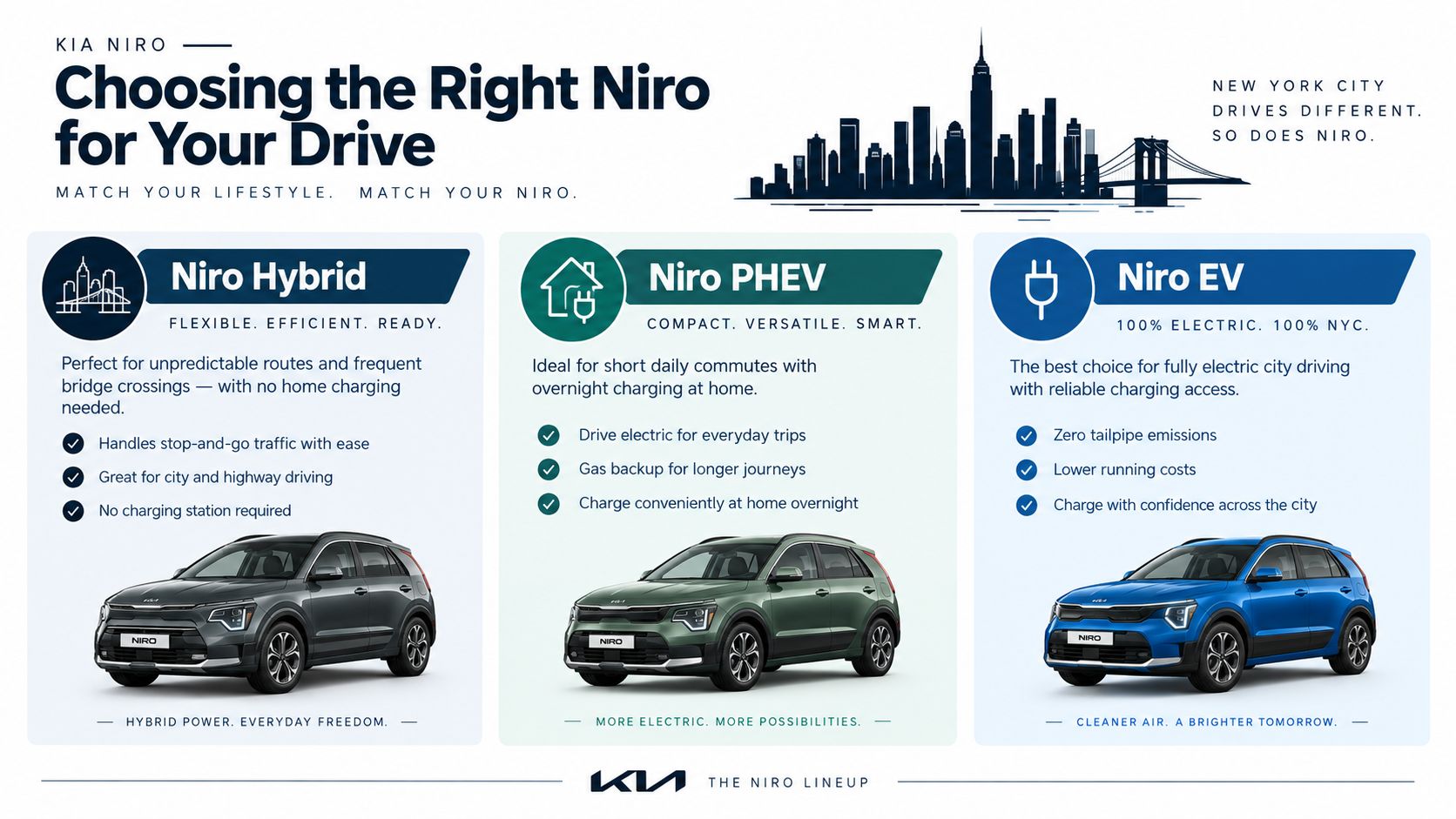
The fastest way to decide is to ask three questions. How far do you drive each day, where does the car sleep at night, and how much do you want to rely on public charging? Your answers point directly to one of the three Niro versions, and that’s the safest way to shop it in New York City.
If you want to compare the new Kia Niro lineup in person, Northstar Kia can walk you through the hybrid, PHEV, and EV options side by side and help you match them to your parking and charging setup. Visit Northstar Kia to see current Niro inventory and talk through which version makes the most sense for your Queens or NYC commute.

0 comment(s) so far on New Kia Niro Lineup Guide for NYC Buyers