


Kia Hybrid Cars: Models, MPG and Costs for NYC Drivers
Kia sold approximately 454,000 hybrid-electric vehicles worldwide in 2025, a 23.7% increase from 2024, according to Hyundai Motor Group’s 2025 results. That scale is why Kia hybrid cars now sit in the middle of a normal shopping list, not off to the side of fully electric models.
For Queens and the rest of New York City, popularity isn’t the decision. The decision is which of six familiar models has a hybrid, how many gallons that setup uses at your mileage, and whether a low-mile driver should skip the hybrid price gap. A hybrid can cut fuel on short, stop-and-go trips. It isn’t automatically the cheaper car to own.
Table of Contents
- Which Kia Hybrid Models You Can Buy in 2026
- How a Kia Hybrid Works, Explained Simply
- Annual Fuel Use by Mileage for Sportage Hybrid Setups
- Ownership Risks to Check Before Buying a Used Hybrid
- Matching a Kia Hybrid to Your Driving and Household
- Financing and Next Steps at Northstar Kia
Which Kia Hybrid Models You Can Buy in 2026
Of the six models in this guide, only the Sportage and the Sorento have a hybrid confirmed in current model information. Start there if a hybrid is the goal, then read the other four rows so you don’t assume a badge that isn’t on the car.
The 2026 Sportage Hybrid is the compact SUV fit for families and commuters. Kia’s 2026 Sportage Hybrid specifications list 232 horsepower on the LX, S, EX, X-Line, and SX-Prestige, with a transmission-mounted electric drive, a 270-volt lithium-ion pouch battery, and a 13.7-gallon fuel tank. You can order front-wheel drive or all-wheel drive. The motor works with the gasoline engine through a six-speed automatic, so this isn’t a separate electric axle you plug in at home.
The Sorento Hybrid and the Sorento Plug-in Hybrid are the mid-size, value-focused choices. The plug-in is the one that can run on grid electricity. Its window-sticker story is different from a conventional hybrid, which only refuels at a gas station. Confirm the model year before you compare payments, because a plug-in from one year and a conventional hybrid from the next are not the same powertrain.
U.S. demand is real, and it is easy to misread. Kia sold 142,326 eco-friendly vehicles in the United States in 2024, up 20% from the year before, according to the Korea Times report on those sales. That total mixes hybrids, plug-in hybrids, and battery-electric vehicles. It is not a hybrid-only count.
Models with no confirmed hybrid
The Telluride, K4, Seltos, and K5 do not have a hybrid confirmed in this research. Treat them as gasoline shops until a specific vehicle shows a hybrid powertrain. Trims change by model year, so match the car on Northstar Kia’s Vehicle Finder before you compare prices.
| Model | Best-fit buyer | Hybrid option | Key figure | Verify at Northstar Kia |
|---|---|---|---|---|
| Sportage | Compact SUV for families and commuters | Sportage Hybrid (FWD or AWD) | 232 hp total output | Trim and drivetrain on Vehicle Finder |
| Telluride | Three-row SUV for larger families | No hybrid confirmed | No hybrid output figure | Current inventory |
| Sorento | Mid-size SUV for value-focused families | Sorento Hybrid and Sorento Plug-in Hybrid | PHEV: 79 MPGe electric, 34 MPG gasoline (2024 EPA) | Model year and powertrain |
| K4 | Affordable sedan for first-time buyers | No hybrid confirmed | No hybrid output figure | Current inventory |
| Seltos | Entry-level SUV for urban buyers | No hybrid confirmed | No hybrid output figure | Current inventory |
| K5 | Mid-size sedan for payment-conscious shoppers | No hybrid confirmed for 2026 | No hybrid output figure | Current inventory |
I would shortlist only a Sportage Hybrid or a Sorento hybrid, then lock the exact trim before talking price. A gasoline Telluride or K5 can still be the right car. It just isn’t the hybrid conversation.
How a Kia Hybrid Works, Explained Simply
Think of the gasoline engine as the steady long-distance runner and the electric motor as the sprint partner. The engine holds highway speed. The motor takes the hard first step when you pull away from a light.
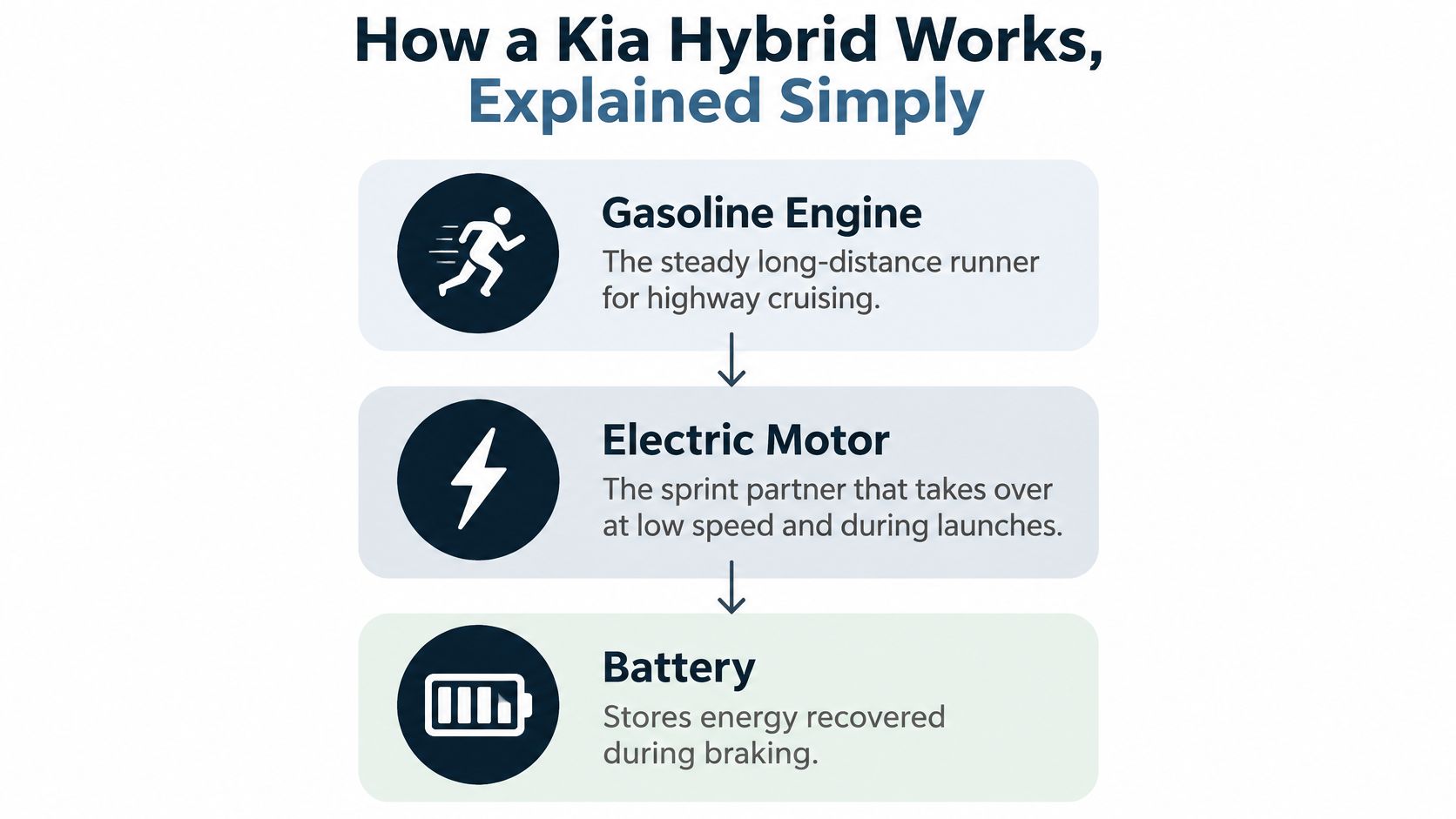
Kia’s conventional hybrid uses a transmission-mounted electric drive. The motor is built into the automatic transmission instead of living in a separate unit or a continuously variable transmission. On the 2025 Sportage Hybrid, Kia’s Sportage Hybrid overview pairs a 1.6-liter turbocharged gasoline engine with electric propulsion for 227 hp and 258 lb-ft of torque. The lithium-ion pouch battery is 270 volts and only 1.49 kWh.
Why the battery stays small
That small pack is intentional. It is a bucket for braking energy, not a reservoir for miles of electric-only driving. It is built to charge and discharge over and over in traffic. A long electric trip would need a much larger battery and a plug. This system doesn’t work that way.
Regenerative braking is a short loop:
- You lift or brake. The motor switches to generator mode and slows the car.
- Motion becomes electricity. Energy that would have heated the friction brakes goes into the battery.
- You accelerate again. Stored energy adds torque so the engine doesn’t carry the whole launch.
Queens avenues, with a light every few blocks, give that loop constant work. A highway cruise gives it much less.
The drivetrain fuel trade
All-wheel drive is not a free upgrade. The same Sportage Hybrid overview rates front-wheel drive at up to 42 mpg combined and all-wheel drive at 35 mpg combined. AWD buys traction in snow and on ramps. It also adds mechanical and rolling losses. If fuel is the priority, front-wheel drive is the setup that earns it.
A 2026 listing shows 232 hp, five horsepower above the 2025 figure. Read the model year on the sticker. Don’t blend the two years into one number.
A conventional hybrid never plugs in. It refills its battery from braking and from the engine.
Annual Fuel Use by Mileage for Sportage Hybrid Setups
Annual gallons equal annual miles divided by rated mpg. The Sportage Hybrid is rated at 42 mpg with front-wheel drive and 35 mpg with all-wheel drive. The chart compares their estimated fuel use at different annual mileages.
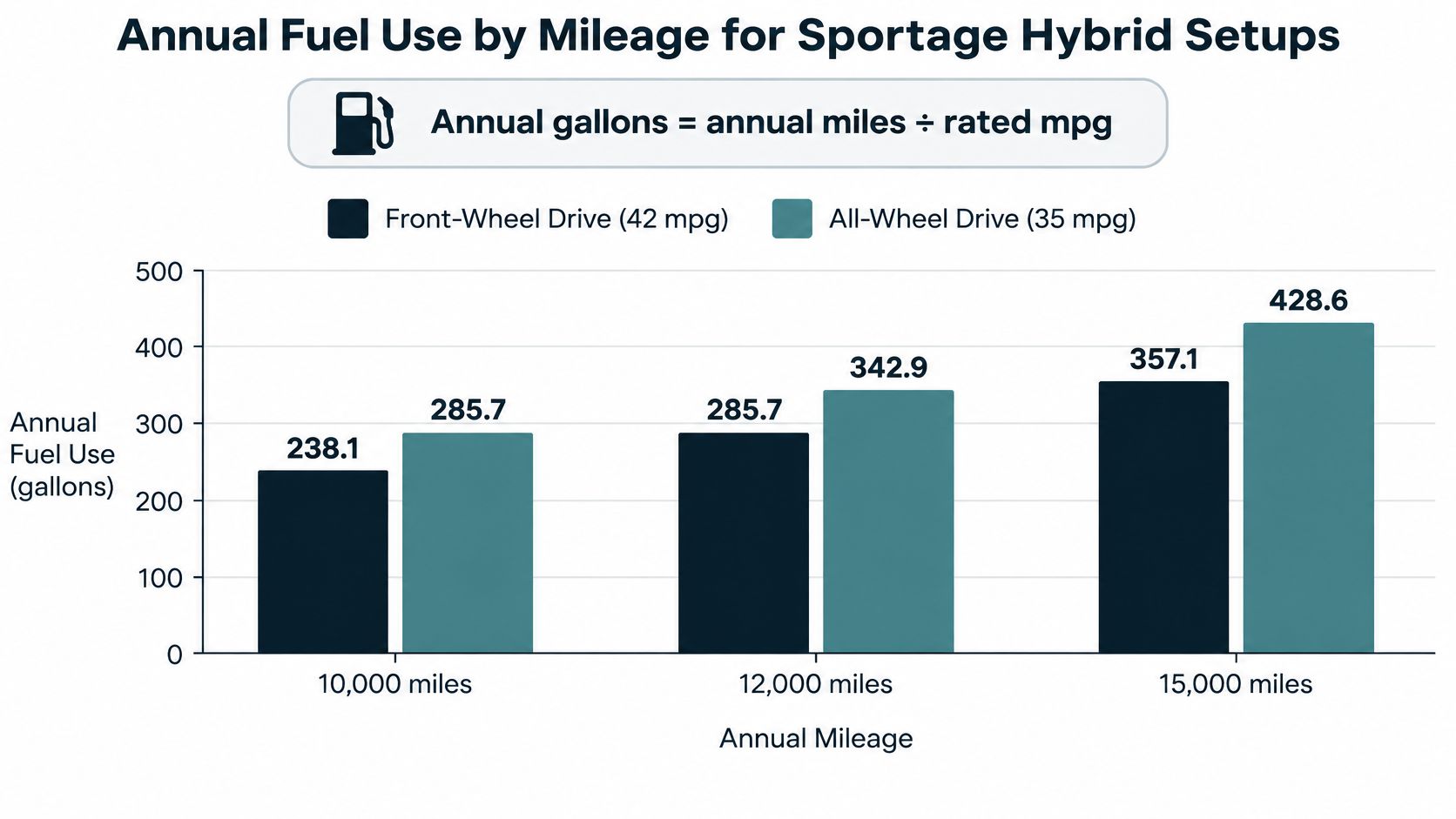
At 5,000 miles a year, front-wheel drive uses about 119 gallons, compared with 143 for all-wheel drive. At 10,000 miles, the estimates are 238 and 286 gallons. At 15,000 miles, they rise to 357 and 429 gallons. The fuel-use gap grows with annual mileage.
| Annual miles | Difference |
|---|---|
| 5,000 miles a year | about 24 gallons |
| 10,000 miles a year | about 48 gallons |
| 15,000 miles a year | about 71 gallons |
Turn gallons into a break-even year
Multiply the annual gallon difference by your local gas price to estimate the yearly fuel-cost gap between the two drivetrains. Then divide any upfront price premium by that yearly amount to estimate how many years it takes to break even. Your purchase-price premium and local pump price are the inputs to enter.
For example, at 10,000 miles a year, the drivetrains differ by about 48 gallons. Multiply 48 by the price you pay per gallon to estimate the yearly fuel-cost difference. If it would take seven years for fuel savings to repay the premium, a buyer keeping the car for four years would not recover that cost.
The Sorento Plug-in Hybrid has a different fuel-use calculation. The U.S. Environmental Protection Agency’s 2024 plug-in hybrid list rates the 2024 model at 79 MPGe combined on electricity and 34 mpg on gasoline. The electric rating depends on regular charging. Once the battery is depleted, the gasoline rating applies.
When the hybrid label doesn’t win
Conventional hybrids can recover more braking energy in stop-and-go driving. Highway-heavy commuting leaves less braking energy to recapture, which can narrow the fuel advantage. Kia groups fuel-saving models under its Kia Gas Efficient Vehicles label. Check the window sticker for the exact trim you are considering.
At 5,000 miles a year, the Sportage Hybrid’s front-wheel-drive and all-wheel-drive setups differ by about 24 gallons. To compare a hybrid with a gasoline trim, use each trim’s window-sticker mpg. Pull the non-hybrid window-sticker mpg for the trim you are considering from its label. For a Queens driver putting fewer than 5,000 miles a year on the car, calculate the annual gallon savings, multiply by local gas price, then compare that amount with the price premium. If fuel savings would take longer to repay the premium than you plan to keep the car, the gasoline trim costs less over your ownership period.
Practical rule: If fuel savings cannot repay the premium before you sell, don’t pay extra for the hybrid.
This walkthrough demonstrates the same gallon calculation on a short drive cycle.
Ownership Risks to Check Before Buying a Used Hybrid
A used hybrid’s ownership risk can come from electronics, warranty limits, and repair delays, not just routine maintenance. A long powertrain warranty does not cover every system in the car.
Kia’s U.S. warranty information advertises a 10-year/100,000-mile limited powertrain warranty. That term alone does not confirm coverage for a used vehicle: check which hybrid components are included, whether battery-capacity concerns are covered, and how labor and ownership transfers are handled. Consumer Reports expects about average reliability for the 2026 Sportage Plug-in Hybrid, but that rating does not answer those warranty questions. Consumer Reports’ reliability page for the 2026 Sportage Plug-in Hybrid
What the warranty does not settle
Powertrain coverage may leave out infotainment, some thermal-management parts, and other electronics. For a used car, confirm in writing what coverage remains and whether it transfers to you before treating the warranty as protection against repair costs.
Driving and storage history matter, too. A car used mostly in city traffic has a different wear pattern from one driven mainly on highways. Outdoor parking and winter road salt can also affect underbody parts and electrical connectors.
| Check | What to verify | Why it matters |
|---|---|---|
| Open recalls | Run a VIN recall check for the hybrid and confirm any open software update has been completed | An open recall may require a remedy before you take ownership |
| Hybrid battery diagnostics | Request a battery-health scan and a check for hybrid-system fault codes | Battery condition affects hybrid assist and potential repair exposure |
| Warranty coverage | Confirm which powertrain components are covered, along with exclusions | Powertrain coverage does not automatically include electronic or infotainment components |
| Warranty transfer | Confirm in writing whether remaining coverage passes to the next owner | Transfer terms affect future repair costs |
| Maintenance records | Review dated service history, including hybrid-related service | Missing records can make warranty questions harder to resolve |
| Accident or flood history | Review a vehicle history report and inspect for signs of water exposure | Water can damage electronic modules |
| Climate and parking exposure | Ask whether the car was routinely parked outdoors or driven on winter roads treated with salt | These conditions can add underbody and connector wear |
| Pending software updates | Ask whether dealer software updates have been completed | Current software supports correct hybrid-system operation |
For a used or certified pre-owned hybrid, get the inspection findings in writing, including the battery scan and recall status. An oil-change record alone does not establish battery condition, warranty eligibility, or whether software updates are complete.
Matching a Kia Hybrid to Your Driving and Household
Match the powertrain to the week you really drive, not to a brochure average.
A Queens commuter with short stop-and-go trips and no charger is the conventional Sportage Hybrid case, and front-wheel drive is the efficient match when snow traction isn’t required. Kia’s 2026 Sportage release describes a 1.6-liter turbo gasoline direct-injection engine with a 47.7-kW electric motor and a six-speed automatic, with front-wheel drive or all-wheel drive, 2,000 pounds of rated towing, and up to 39.5 cubic feet of rear cargo. That cargo and tow rating covers strollers, weekly shopping, and a small trailer without stepping into a three-row.
Larger families and plug-in households
The Telluride has no confirmed hybrid, so a larger family that wants three rows should compare confirmed gasoline trims or ask what future inventory shows. Don’t wait on a hybrid Telluride that this research doesn’t confirm.
Value-focused families can split the Sorento two ways. The conventional Sorento Hybrid fits everyday driving with no home charger. The Sorento Plug-in Hybrid fits a household that can charge at home or in a garage often enough to use electric miles. A plug-in that rarely charges behaves like a heavier gasoline hybrid.
Buyers with no confirmed hybrid
First-time buyers on the K4 and payment-conscious shoppers on the K5 don’t have a confirmed hybrid here. The hybrid question becomes a trim check, not a default. Urban buyers on the Seltos are in the same spot. Compare that gasoline model’s window sticker directly instead of waiting for a hybrid that isn’t confirmed.
If most trips are short and charging isn’t available, choose a conventional hybrid over a plug-in. If you don’t need all-wheel drive for weather, choose front-wheel drive for the stronger rating. If you drive very few miles, go back to the gallon math before you pay a hybrid premium at all.
Financing and Next Steps at Northstar Kia
Northstar Kia is a franchised Kia dealership on Northern Blvd in Woodside, Queens, serving Brooklyn, the Bronx, Long Island, and greater NYC. The useful next step is a short list you can price, not a tour of every SUV on the lot.
Six steps before you sign
- Shortlist confirmed hybrids only. That means a Sportage Hybrid in front-wheel drive or all-wheel drive, a Sorento Hybrid, or a Sorento Plug-in Hybrid. Leave the Telluride, K4, Seltos, and K5 on a gasoline list unless a specific unit shows a hybrid powertrain.
- Lock the build. Use the Vehicle Finder Service for trim, drivetrain, and model year. A 2025 output figure and a 2026 output figure are not interchangeable, and an all-wheel-drive hybrid will not match a front-drive fuel rating.
- Inspect used and certified cars first. Run the VIN recall check. Ask for battery diagnostics and dated service records before you talk payment. Certified pre-owned benefits are the ones the site lists for that program. Used inventory includes cars priced under $20,000 where the site shows them. Neither label replaces the battery scan.
- Prequalify before the visit. Start with the Finance Center online application or Capital One pre-qualification. You walk in knowing a likely approval range instead of guessing from a monthly ad.
- Run the payment calculator. Enter price, down payment, term, and rate. Compare 48-, 60-, and 72-month terms for both the monthly payment and total interest. A longer term can lower the month and raise the interest you pay. Use Value Your Trade to cut the amount financed. Confirm current specials, lease and finance incentives, and any hybrid-specific offer on that trim, because those terms change.
- Book the drive for both kinds of road. Schedule online. Ask for Spanish-language sales and service support if you want it. Drive stop-and-go blocks and a stretch of highway so you can feel low-speed regenerative braking against steady-speed behavior. The city loop is where a conventional hybrid does its work. The highway shows you what it doesn’t save.
The decision that matters most is which confirmed hybrid you test first. For a no-charger city commute, I would start with a front-wheel-drive Sportage Hybrid. For a family that can charge at home, I would start with the Sorento Plug-in Hybrid and ask how often that household will plug in.
Northstar Kia stocks Sportage Hybrid and Sorento hybrid configurations for Queens and greater NYC drivers, along with gasoline trims of the Telluride, K4, Seltos, and K5 when a hybrid isn’t confirmed. Use the Vehicle Finder, the payment calculator, and a VIN check so the hybrid you finance matches your miles and your charger access. Visit Northstar Kia to shortlist a confirmed hybrid and schedule the test drive.
0 comment(s) so far on Kia Hybrid Cars: Models, MPG and Costs for NYC Drivers