


Used Kia Electric Buyer Guide for NYC
Kia sold 100,118 electric vehicles in South Korea between January 1 and September 17, 2026, more than twice the 45,518 sold during the same period a year earlier. Electric models made up 23.8% of Kia’s domestic sales, so nearly one in four Kia vehicles sold there was electric, according to Yonhap News Agency’s report on Kia’s EV sales. That scale matters to a New York City buyer because it signals a growing supply of familiar Kia EVs, more used inventory over time, and stronger pricing history across major markets.
The sharper point is financial. A used Kia electric vehicle can combine modern driving technology with the steep depreciation that new-car buyers absorb. In New York City, where apartment parking, unpredictable fuel costs, and expensive ownership decisions punish mistakes, the right pre-owned EV can be a smart purchase. The wrong one, especially one with weak battery documentation and little warranty remaining, can become an expensive gamble.
Table of Contents
- The Financial Case for a Pre-Owned Kia EV
- Choosing Between the EV6 and Niro EV
- Evaluating Battery Health and Degradation
- Navigating the Battery Warranty and Replacement Costs
- Managing Charging Infrastructure in New York City
- Executing a Thorough Pre-Purchase Inspection
- Finalizing Your Purchase with a Local Dealership
The Financial Case for a Pre-Owned Kia EV
Steep depreciation makes a used Kia EV financially interesting, but only when the discount covers the risks that matter in New York City. A lower purchase price can offset the cost of charging, insurance, garage access, and the possibility of expensive work after warranty coverage ends. It does not compensate for a car with unclear battery records or no practical charging plan.
The Kia EV6 shows how sharply the first owner can absorb the loss. iSeeCars’ 2026 resale analysis estimated that the EV6 would retain 40.6718% of its value after five years, implying approximately 59% depreciation. Its three-year depreciation was reported at 46.4%, and its estimated five-year resale value was approximately $17,549 on an MSRP-based calculation. Those figures appear in this summary of iSeeCars’ Kia EV depreciation analysis.
Why depreciation changes the buying decision
Depreciation does not prove that an EV is a poor vehicle. It reflects changing technology, incentive effects, new-model competition, and buyer uncertainty. A used-car buyer can acquire a vehicle after much of that initial value loss while retaining quiet operation, strong acceleration, useful technology, and lower routine mechanical complexity.
The Kia EV9 follows the same pattern at a larger scale. The same iSeeCars 2026 analysis estimated 37.0919% value retention after five years, implying roughly 62.8% depreciation, with an estimated five-year resale value of about $20,435. Its larger cabin may suit a family, while the EV6 generally fits urban ownership better because its footprint is easier to manage in tight garages and crowded streets.
For a New York City buyer, depreciation should be weighed against warranty coverage, not considered in isolation. Confirm that the battery warranty transfers to you, identify its remaining coverage, and obtain the vehicle’s warranty and service records before making an offer. A low price with little transferable protection can leave you exposed to a repair bill that erases the apparent bargain.
Financial rule: Do not compare a used Kia EV only with the price of a new Kia EV. Compare it with the total cost of an equivalent gasoline or hybrid vehicle, including energy, maintenance, insurance, parking, and the risk of an out-of-warranty battery repair.
A used Kia electric purchase works when three conditions align: documented battery health, meaningful warranty protection, and a discount that compensates for charging logistics. Street parking in Queens or Brooklyn changes the calculation. Manhattan garage rates, Bronx and Staten Island driving patterns, and limited overnight access in any borough can all affect ownership costs. Set up a realistic charging plan before signing, then use the inspection and warranty documents to decide whether the savings are real.
Choosing Between the EV6 and Niro EV
The Kia EV6 and Kia Niro EV serve different New York City buyers. The EV6 is the more distinctive, performance-oriented choice, with a lower, sleeker shape and a driving experience that feels closer to a sportback than a conventional small crossover. The Niro EV takes the practical route. Its upright crossover design makes it easier to load, easier to judge in traffic, and better suited to buyers who prioritize everyday usability over style.
Neither is automatically the correct choice for Manhattan, Queens, Brooklyn, the Bronx, or Staten Island. The right decision depends on where you park, how often you carry passengers, and whether your driving includes regular trips beyond the city.
Urban comparison
| Feature | Kia EV6 | Kia Niro EV |
|---|---|---|
| Driving character | More athletic and performance-focused | Calm, practical, and easygoing |
| Body design | Low, streamlined crossover | Upright compact crossover |
| Tight garage use | Lower seating position and longer-feeling proportions require careful parking | More familiar crossover proportions can feel easier to place |
| Passenger access | Sportier roofline may feel less open to rear passengers | More conventional cabin access suits daily family use |
| Cargo practicality | Useful, but the sloping rear design prioritizes style | Boxier shape makes loading groceries, strollers, and equipment simpler |
| Best urban fit | Drivers who value quick responses and distinctive design | Drivers who want straightforward utility and easier daily living |
| Weekend travel | Better for buyers who want a more engaging highway drive | Better for buyers who prioritize usable space and relaxed practicality |
The EV6 is the choice for a driver who enjoys the vehicle itself. Its lower profile may make entry and exit less convenient in a crowded garage, and its shape demands closer attention when loading bulky items. In return, it feels more special on an open road and better matches a buyer who wants an EV that doesn’t drive like an appliance.
The Niro EV is the safer recommendation for many households. It gives up some visual drama, but it makes school runs, grocery loading, curbside errands, and passenger access less complicated. That matters in New York, where the vehicle spends as much time dealing with tight spaces, double-parked traffic, rough pavement, and loading zones as it does cruising at speed.
Match the car to your parking reality
Choose the EV6 if you have reliable access to charging, prefer a lower driving position, and regularly travel outside the city. Choose the Niro EV if you want an easier crossover shape, carry passengers frequently, or treat cargo access as a daily priority.
Do not choose based solely on the dashboard, trim name, or exterior color. Sit in the rear seat, open the liftgate in the actual parking environment you use, and measure whether your preferred charger location gives you enough cable reach. A beautiful EV that frustrates you every night is a poor urban purchase.
Evaluating Battery Health and Degradation
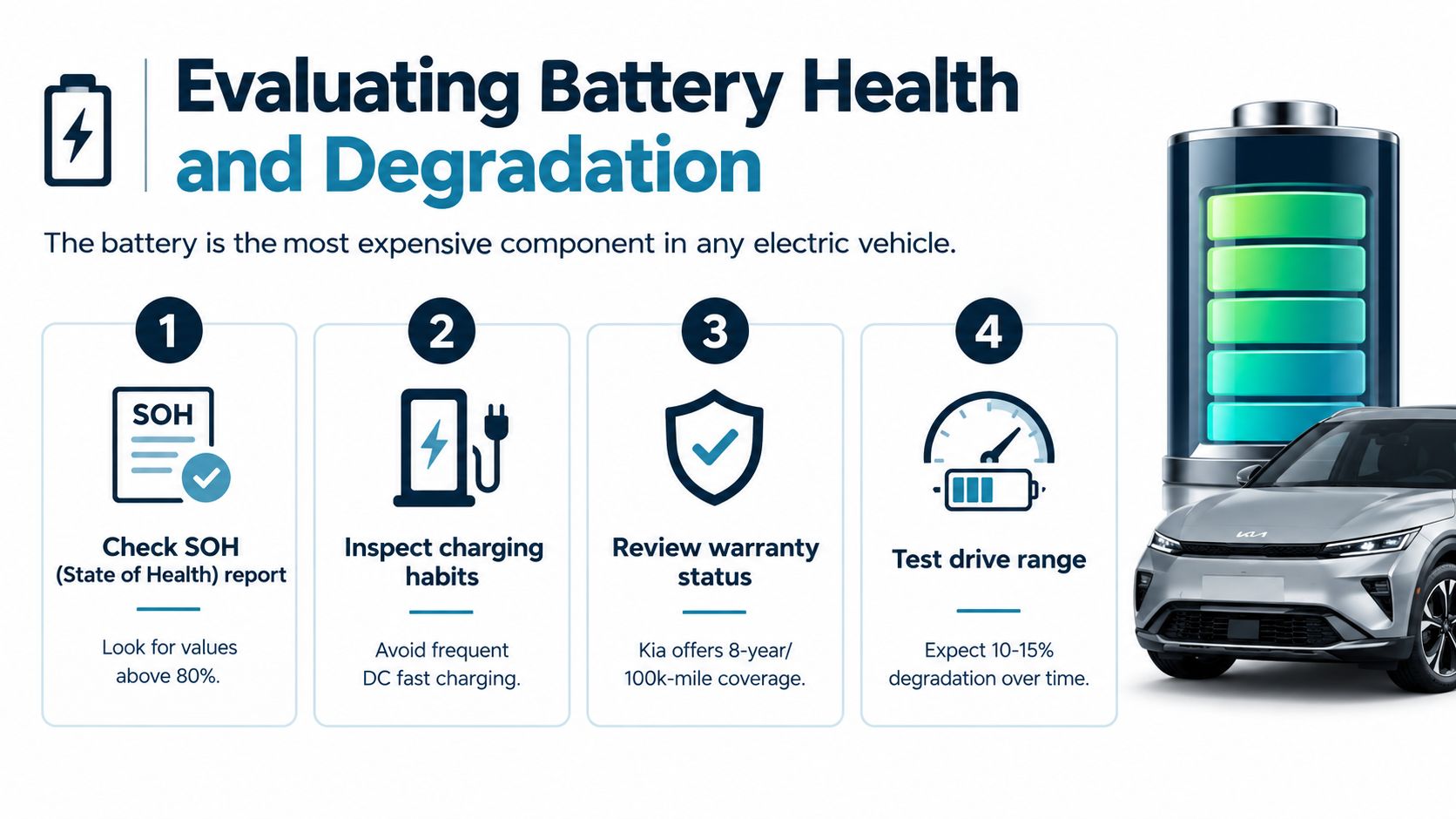
Battery condition matters more than the odometer. Mileage tells you how much the vehicle has traveled, but it doesn’t reveal how often the owner used DC fast charging, whether the battery regularly sat fully charged, or whether the vehicle spent years in a harsh climate.
A 2025 battery-health analysis reported by TechRadar identified the Kia EV6 and Kia e-Niro among the stronger performers, with the EV6 statistically ranking at the top of that analysis. The reporting also noted that many vehicles retained 90% or more of their original battery capacity, while climate and charging behavior could matter more than brand alone.
Start with a documented State of Health report
Ask the seller for a battery diagnostic report, not a verbal assurance that the car “holds a charge.” The report should identify the battery’s State of Health, charging faults, recorded repairs, and any warning history. If the seller can’t produce meaningful battery information, arrange an inspection with a Kia service department or an EV-qualified technician before making an offer.
Then compare the reported capacity with the vehicle’s expected real-world performance. Don’t treat a dashboard range estimate as a laboratory measurement. Weather, heating, air conditioning, traffic, tire pressure, and driving speed can change the estimate, so use the number as a clue rather than proof.
Read the ownership history
Charging behavior deserves direct questions:
- Ask about DC fast charging: Frequent use can place greater thermal demand on the battery than a sensible mix of home or Level 2 charging.
- Look for deep-discharge habits: Regularly allowing the battery to fall below 10% can accelerate degradation, according to the battery-health guidance summarized by TechRadar.
- Check repeated full charging: Regularly charging to 100% can also contribute to faster degradation, especially when the vehicle sits at that level.
- Review climate history: A vehicle that spent years in extreme heat may deserve more scrutiny than one operated in a milder environment.
- Confirm charging performance: The car should begin charging normally, maintain the session, and avoid warning messages or unexplained interruptions.
A clean exterior doesn’t prove a healthy pack. Conversely, a higher-mileage EV with sensible charging habits and a strong diagnostic report may be a better purchase than a low-mileage vehicle with an unclear history.
The inspection should include a test drive long enough to observe power delivery, regenerative braking, cabin heating, and the range estimate under normal city conditions. You’re looking for consistency, not a specific range number. Sudden drops, charging errors, or reduced power require professional diagnosis.
Watch this overview before arranging an inspection:
Navigating the Battery Warranty and Replacement Costs
A used Kia EV is only as financially sensible as its remaining battery protection. Kia documentation describes battery-capacity coverage for capacity falling below 70% of original capacity, with some markets listing 8 years or 100,000 miles and a U.S. warranty manual listing 10 years or 100,000 miles for the EV battery. The applicable term depends on the vehicle, market, warranty document, in-service date, and conditions, so verify the exact coverage for the VIN.
The protection generally follows the vehicle to a second owner, which makes warranty transferability a major part of the used-car equation. You’re not buying just a battery. You’re buying a battery with a remaining period of manufacturer-backed capacity protection, assuming the eligibility requirements remain satisfied.
Verify the warranty before discussing price
Ask the dealership or Kia service department to confirm:
- The in-service date: Warranty time usually runs from when the vehicle entered service, not from the day you purchase it used.
- The mileage status: Check the vehicle’s current mileage against the applicable limit.
- The capacity threshold: Confirm how the manufacturer defines and tests capacity below the 70% trigger.
- Transfer status: Make sure the coverage follows the vehicle and that no documentation issue prevents a second owner from using it.
- Service records: Review battery repairs, replacements, software work, charging-system diagnoses, and accident history.
Don’t accept “the battery warranty is still active” as a complete answer. You need the remaining time and mileage, the applicable market terms, and confirmation that the vehicle qualifies.
Understand the out-of-warranty exposure
A full Kia EV6 high-voltage battery replacement is currently estimated at roughly $10,000 to $15,000 out of warranty. Broader Kia battery guidance places replacement costs at approximately $12,000 to $28,000, depending on model, pack size, and labor, as outlined in this Kia EV battery replacement cost guide.
Those estimates don’t mean every battery problem requires a complete pack replacement. A technician may diagnose a module, connection, cooling component, sensor, or charging fault instead. But a buyer must price the car with the possibility of a major repair in mind, especially when the warranty is close to expiring.
The purchase-price discount must compensate for the warranty risk. A cheap EV with weak battery evidence isn’t cheap if the discount disappears during one major repair.
A used Kia EV with strong State of Health, clean service records, and substantial transferable coverage is a different financial product from an older example with uncertain history. Treat those cars differently during negotiation. Pay more for verified protection when the alternative is assuming an unpriced mechanical liability.
Managing Charging Infrastructure in New York City
A suburban EV buyer can often install a home charger and make charging routine. A New York City buyer may have no driveway, no assigned space, and no control over where the car sits overnight. That changes the ownership calculation before the vehicle ever reaches the curb.
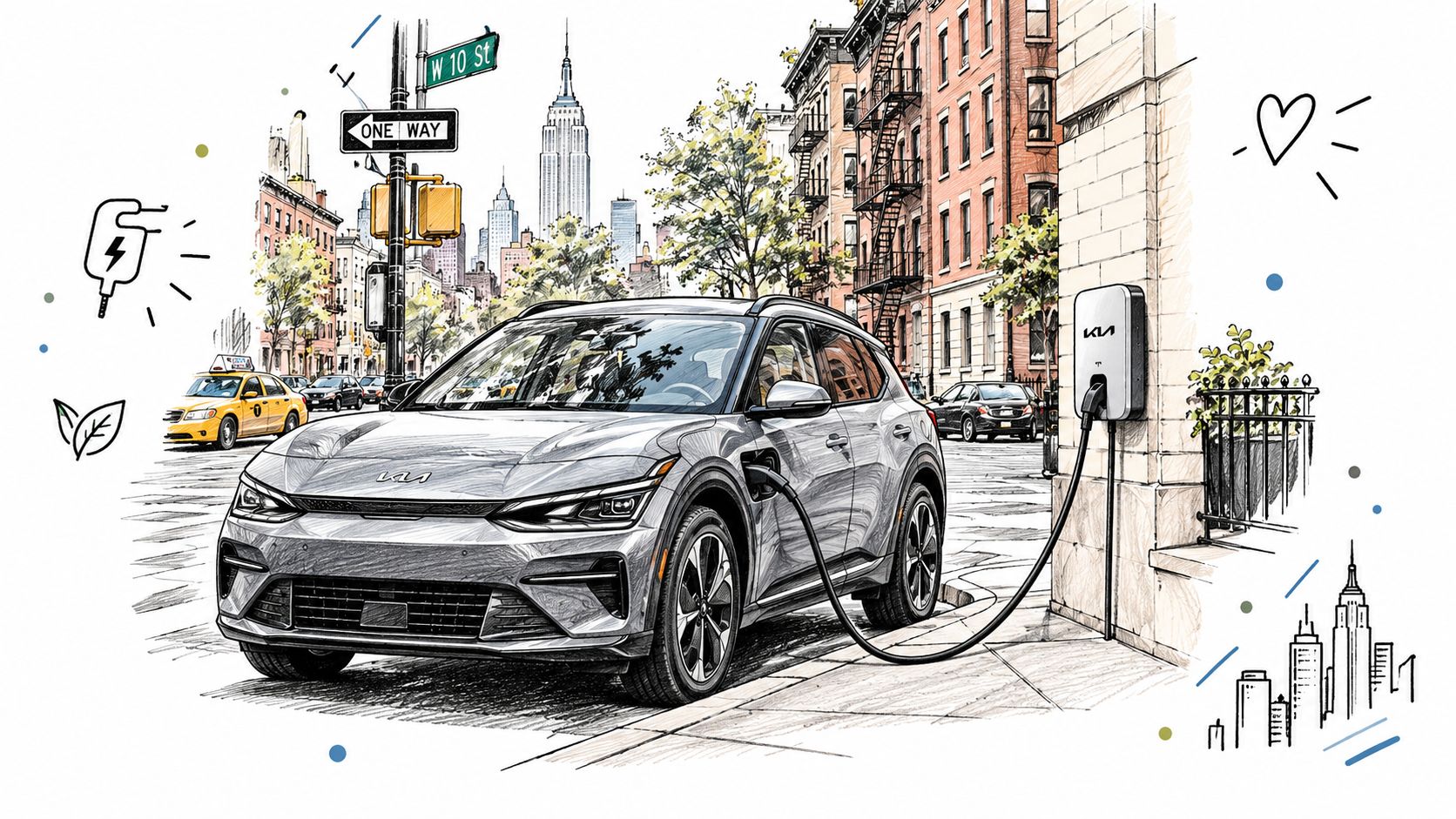
A driver in Queens might park on the street near an apartment, use a public Level 2 charger while shopping, and rely on a faster charger before leaving the city for a weekend trip. A Brooklyn driver might have access to a garage but face a waiting list for a charging space. These situations aren’t theoretical inconveniences. They determine whether an EV feels effortless or becomes a weekly scheduling problem.
Build a charging routine before buying
Start with your actual neighborhood, not a general charging map. Identify public chargers near home, work, supermarkets, gyms, and routes you already use. Then check whether the locations are practical at the times you need them, whether parking rules limit dwell time, and whether the equipment supports the vehicle’s charging requirements.
A reliable routine usually combines several options:
- Primary charging: Use a regular Level 2 location near home or work whenever possible.
- Backup charging: Keep a second location available in another part of the borough for occupied or broken equipment.
- Trip charging: Plan faster charging around errands or meal stops instead of waiting in a dedicated location without another task.
- Street-parking discipline: Never assume a public charger will be free when your battery is low.
- Cold-weather planning: Allow extra time and energy in winter because cabin heating and lower temperatures can reduce efficiency.
The EV6’s faster-charging capability can reduce the inconvenience of apartment living, but it doesn’t eliminate the need for planning. The Niro EV may suit a driver whose routine favors slower, predictable charging and shorter daily trips.
Don’t buy before testing the routine
Borrow or rent an EV if you’re uncertain about public charging, then follow your normal Queens or Brooklyn schedule. See how often you need to detour, whether charger locations are safe and convenient, and whether you can leave the vehicle long enough to complete a useful session.
If charging requires a long cross-borough trip every few days, the financial savings from depreciation may not justify the daily friction. If a charger sits along your commute or near a regular destination, a used Kia electric vehicle becomes much easier to live with.
Executing a Thorough Pre-Purchase Inspection
A standard used-car inspection isn’t enough for an EV. The technician must evaluate the high-voltage system, charging equipment, cooling system, software faults, and accident damage that could affect battery safety.
Begin with the vehicle history report, but don’t stop there. Confirm that the VIN, title, mileage, service records, and battery warranty information all match. An EV that has changed hands through an auction may deserve more scrutiny than one with consistent Kia service documentation.
Inspect the exterior and charging hardware
Open the charging-port door and use a flashlight. Look for moisture, corrosion, bent pins, discoloration, melted plastic, cracked housing, or evidence that someone forced a connector into place. Damage around the port can indicate repeated charging problems or collision repair.
Inspect the underside without touching high-voltage components. Orange cables should be properly routed and free from visible chafing, crushing, exposed conductors, or improvised repairs. Don’t remove covers or handle high-voltage connectors yourself. A qualified technician should inspect anything that appears damaged.
Check the battery case and nearby underbody panels for dents, scrapes, punctures, and impact marks. New York roads and parking ramps can expose the underside to harsh contact, and damage to the battery enclosure deserves immediate professional attention.
Test systems while driving
During the test drive, turn on the cabin heat and air conditioning. Listen for unusual pump, fan, or compressor sounds, and watch for warning messages. Test regenerative braking at different speeds, then apply the friction brakes normally. The transition should feel controlled rather than abrupt or inconsistent.
Use the following checklist before accepting the car:
- Charging session: Plug the vehicle in and confirm that charging begins without repeated resets or warning lights.
- Power delivery: Accelerate smoothly and watch for hesitation, reduced-power messages, or unusual vibration.
- Steering and suspension: Check for pulling, clunks, uneven tire wear, and damage caused by rough pavement or curb impacts.
- Cabin electronics: Test the display, cameras, climate controls, heated seats, navigation, phone connection, and driver-assistance alerts.
- Tires and alignment: Uneven wear can reveal suspension damage or aggressive driving, and EV torque can expose weak tires quickly.
- Recall and software status: Ask the service department to check open campaigns, battery work, and relevant software updates.
Inspection standard: If the seller won’t allow an independent EV inspection or a charging test, walk away. A polished interior doesn’t reduce electrical risk.
Finalizing Your Purchase with a Local Dealership
The strongest used Kia EV transaction combines a sensible price with documented condition. Start with the battery report and warranty status, then add the physical inspection, charging test, service records, and vehicle-history review. If any one of those pieces is missing, negotiate from uncertainty or choose another vehicle.
A franchised Kia dealer can be useful because its service department has access to Kia-specific diagnostic procedures and warranty records. An independent EV specialist may also provide valuable battery testing, especially when you want a second opinion before purchase. Use the professional who will give you evidence rather than reassurance.
Make the transaction fit your city life
A local dealership can also simplify practical parts of the purchase. Look for inventory search tools when you need a specific trim or battery configuration, online trade-in appraisal when you’re replacing another car, and financing tools that let you estimate payments before visiting. Multilingual staff can make the buying process clearer for households that prefer Spanish-language support.
Ask for the out-the-door price in writing. Review vehicle price, taxes, registration, documentation fees, financing terms, warranty products, and any installed accessories. Don’t let a low monthly payment hide a high total cost or a long loan term on a rapidly depreciating vehicle.
For a Queens buyer, Northstar Kia in Woodside offers pre-owned and certified pre-owned inventory, EV research resources, vehicle-finder assistance, on-site financing, and a Kia service and parts department. Those resources can help you compare an EV6 or Niro EV, verify its condition, and plan maintenance near home rather than treating the purchase as a one-day sales decision.
The best used Kia electric purchase is not necessarily the cheapest listing. It’s the vehicle with a defensible price, strong battery evidence, usable charging access, and enough remaining warranty to make the ownership risk manageable. If you can’t verify those points, keep shopping.
Northstar Kia offers pre-owned and certified pre-owned Kia vehicles, EV research support, financing tools, trade-in assistance, and on-site service for buyers comparing used electric models in Queens and the greater New York City area. Visit Northstar Kia to review available EV inventory and arrange a professional inspection before you buy.
0 comment(s) so far on Used Kia Electric Buyer Guide for NYC