


New Kia K5: NYC Buyer’s Guide to Trims and Tech
The new Kia K5 gives you two distinct choices: a standard 2.5-liter engine with 191 horsepower for efficient commuting, or a turbocharged GT with 290 horsepower for sharper acceleration. For most Queens drivers, the standard engine is the smarter daily choice, while the GT makes sense when performance matters more than fuel economy.
You’re probably not choosing a car for one kind of trip. Your morning may begin with tight streets in Jackson Heights, continue through traffic toward Long Island City, and finish with a highway merge where you need confident acceleration. Add parallel parking, winter weather, family errands, and fuel costs, and the right K5 depends less on appearance than on how its engine, drivetrain, and technology fit your routine.
The new Kia K5 is useful because it doesn’t force every buyer into the same personality. It remains a midsize sedan with practical space, but its range separates relaxed efficiency from serious four-cylinder performance. Here’s how I’d evaluate it for a Queens or greater New York City commute.
Table of Contents
- Choosing Your New Kia K5 for NYC Driving
- Navigating the Kia K5 Trim Levels
- Comparing Performance and Fuel Economy
- Essential Tech and Safety Features for the City
- Evaluating Practicality and Space for Families
- Finding Your Best Match at Northstar Kia
Choosing Your New Kia K5 for NYC Driving
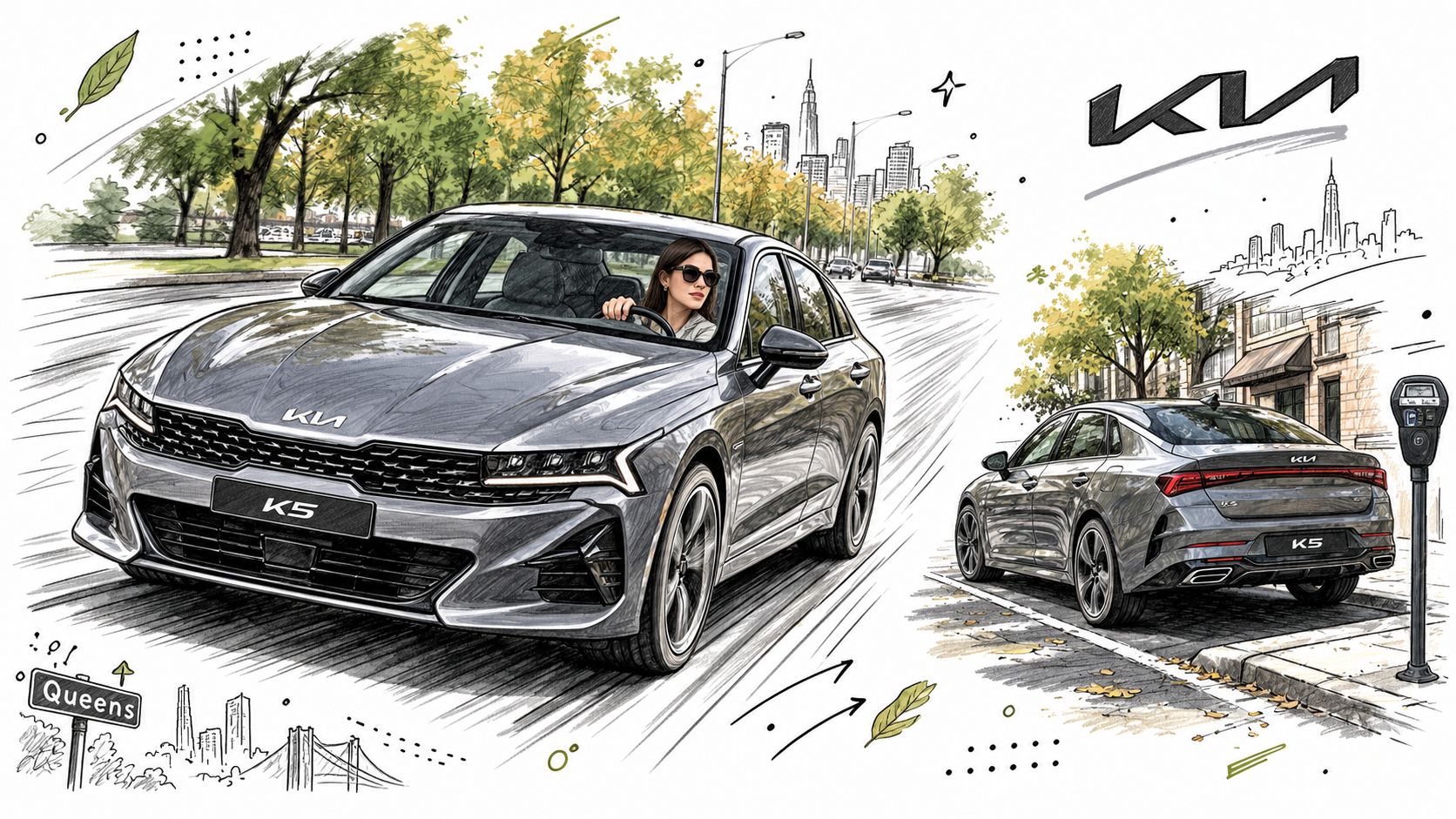
A commuter in Queens can spend one stretch of the day creeping through congested intersections and another cruising on the Grand Central Parkway. That’s why the first K5 decision shouldn’t be about choosing the flashiest trim. It should be about deciding whether your daily priority is lower fuel consumption, additional traction, or immediate acceleration.
The standard K5 is the logical starting point for drivers who want a calm, predictable sedan. Its naturally aspirated engine avoids turbocharger complexity and works with a conventional eight-speed automatic transmission. That combination suits stop-and-go traffic, routine errands, and longer commutes where smooth response matters more than dramatic power.
The GT takes a different approach. Its turbocharged engine produces a substantial reserve of power, which you’ll notice when joining a busy highway, passing slower traffic, or carrying passengers through an uphill stretch. It’s not just a cosmetic upgrade. The GT changes the character of the car and asks you to accept higher fuel consumption in exchange for stronger response.
Start with your actual commute
Use your usual route as the test. If your K5 will spend most of its time in urban traffic, parking garages, and moderate-speed suburban roads, the standard powertrain provides enough performance without making every trip a fuel-versus-fun calculation. If you regularly drive outside the city and dislike waiting for a safe passing opportunity, the GT deserves a closer look.
AWD adds another decision. It’s available on the GT-Line, not throughout the lineup, and it can provide extra traction on wet, snowy, or poorly cleared streets. It won’t make the K5 an off-road vehicle, and it comes with lower fuel economy than comparable front-wheel-drive configurations. For a driver who rarely faces difficult weather, front-wheel drive is the cleaner choice.
Practical rule: Choose the engine first, then choose the trim that gives you the equipment you’ll use every day.
The K5’s midsize footprint also matters in New York. It gives the sedan a stable highway presence and a roomy cabin, but you’ll still need to judge its length against your regular garage, driveway, or parking space. A test drive should include tight turns and low-speed maneuvering, not just a smooth dealership-road loop.
Navigating the Kia K5 Trim Levels
The K5 trim ladder is easiest to understand when you treat each version as a different answer to a city-driving problem. Don’t move upward just because a higher badge sounds more complete. Move upward when a specific feature, drivetrain, or driving character solves something you encounter regularly.
LXS for straightforward commuting
The LXS is the practical entry point. It’s the trim I’d direct toward a buyer who wants the K5’s midsize-sedan format and standard powertrain without paying for a sportier appearance or a more luxurious cabin.
Its strongest argument is simplicity. You get the naturally aspirated 2.5-liter engine, front-wheel-drive efficiency in the appropriate configuration, and the core driver-assistance equipment expected in a modern sedan. For a commuter who spends more time in traffic than on open roads, that basic formula makes sense.
GT-Line for urban style and available traction
The GT-Line is the most interesting middle choice for many New York-area buyers. It adds a more assertive presentation and can be configured with AWD, making it the trim to investigate if you want stronger bad-weather confidence without stepping directly into the performance-focused GT.
Choose it for the balance. You’ll get a K5 that looks more purposeful and can offer additional traction when conditions turn unpleasant, but you should remember that AWD carries an efficiency trade-off. If your priority is maximum mileage, stay with front-wheel drive where available.
EX for a more refined cabin
The EX targets drivers who spend a lot of time inside the vehicle and care about comfort-oriented equipment. It makes sense for a professional commuter, a family driver, or anyone who sees the K5 as a daily living space rather than just transportation.
The right question is whether the added cabin technology and convenience features will improve your routine. If you frequently sit in traffic, make long drives, or carry passengers, refinement can matter more than exterior styling. If your trips are short and your budget is tightly controlled, the LXS may remain the better value.
GT for acceleration
The GT is the clear performance choice. It pairs the turbocharged engine with an eight-speed wet dual-clutch transmission and focuses on quicker response rather than maximum economy. Select it because you really want the power, not because you expect it to be the most sensible commuter configuration.
A simple buying sequence works well:
- Choose the powertrain: Standard for efficiency and smoothness, GT for acceleration.
- Choose the drivetrain: Front-wheel drive for economy, AWD for added weather traction where available.
- Choose equipment: Move from LXS to GT-Line or EX only when the design, comfort, or technology justifies it.
- Verify the safety package: Confirm which cameras and rear-collision features are included on the exact vehicle.
That final step matters because equipment can vary by trim and package. A higher price doesn’t automatically answer every safety or parking concern.
Comparing Performance and Fuel Economy
A Queens commuter leaving a tight parking spot, crawling through Queens Boulevard traffic, then merging onto the Long Island Expressway needs more than a horsepower headline. The standard K5 and the GT use different engines and transmissions, so the choice affects acceleration, low-speed smoothness, fuel use, and winter drivetrain decisions.
The standard 2.5-liter naturally aspirated inline-four makes 191 horsepower at 6,100 rpm and approximately 181 to 182 pound-feet of torque, according to Kia’s 2026 K5 specifications. With front-wheel drive, its EPA ratings reach 26 mpg city, 37 mpg highway, and 30 mpg combined. Comparable all-wheel-drive versions reach roughly 29 mpg combined.
That is my pick for most Queens drivers. The engine has enough output for ordinary merging and passing, while the conventional eight-speed automatic handles stop-and-go traffic, tight turns, and repeated low-speed transitions smoothly. It gives up the GT’s acceleration, but it makes better sense for a daily driver that spends more time in congestion than on open highway.
| Configuration | Output | Transmission | EPA fuel economy |
|---|---|---|---|
| Standard 2.5-liter | 191 horsepower, 181 to 182 lb-ft | Eight-speed automatic | Up to 26 city, 37 highway, 30 combined |
| Turbocharged GT | 290 horsepower, 311 lb-ft | Eight-speed wet dual-clutch | Approximately 23 city, 33 highway, 27 combined |
The GT figures are covered by Car and Driver’s Kia K5 coverage. Its turbocharged 2.5-liter reaches peak torque at 1,650 rpm, giving the sedan stronger response during everyday street driving without waiting for high engine speed. That advantage shows up when joining a fast roadway, passing a slower vehicle, or carrying several passengers.
The GT produces 99 more horsepower and 130 additional pound-feet of torque than the standard engine, as documented in Kia’s 2026 K5 specifications. The older Kia’s 2025 K5 specifications should not be used to compare current 2026 inventory.
The transmission matters in traffic
The standard K5’s torque-converter automatic is the better urban tool. The GT’s wet dual-clutch transmission shifts quickly and transfers power efficiently, but it can feel less relaxed while creeping through congestion or easing into a narrow parking space. Drive both versions before committing, especially if your routine includes frequent garage ramps, curbside parking, and winter traffic.
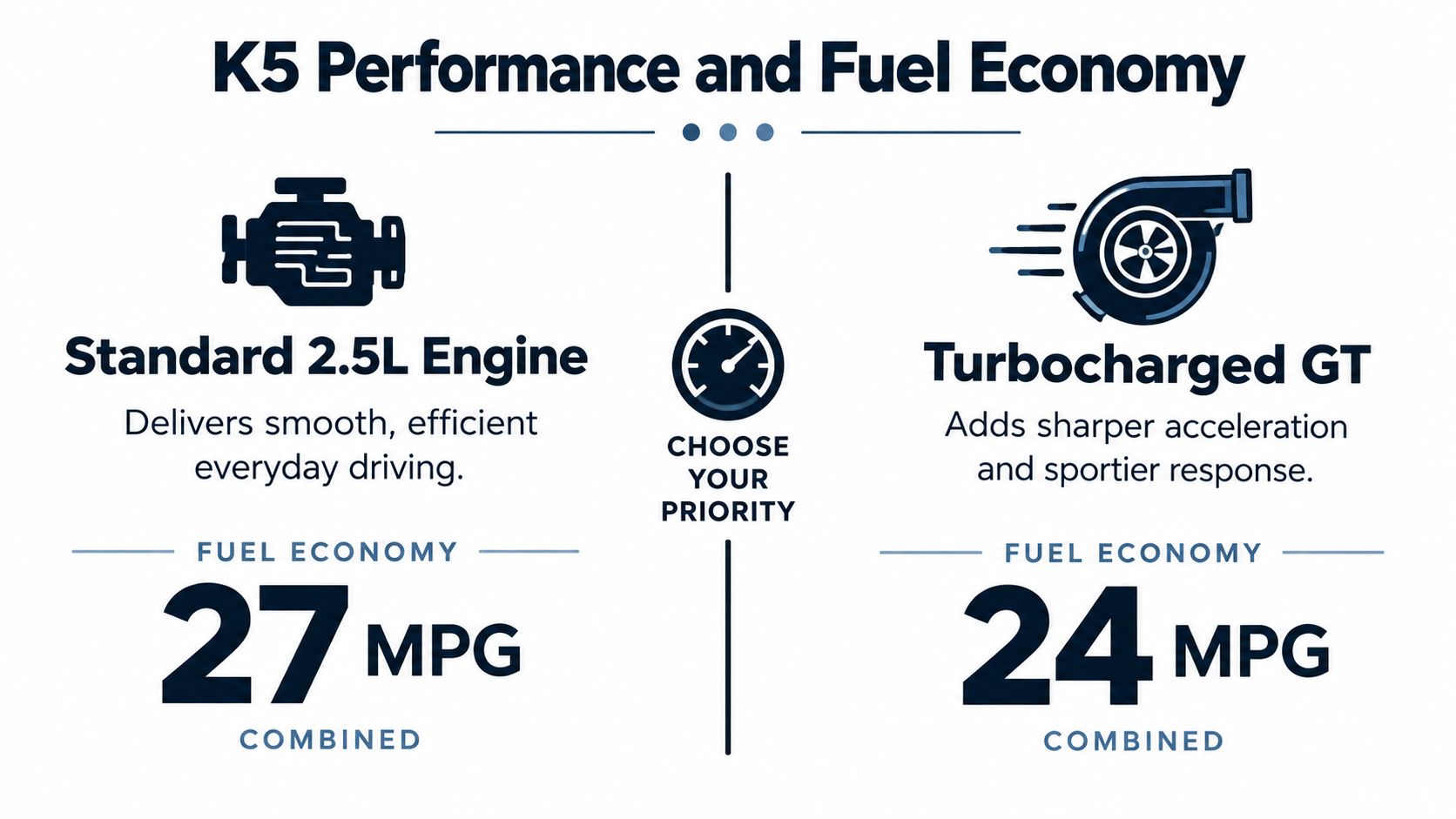
My recommendation: Buy the standard K5 unless stronger acceleration matters enough to accept the GT’s lower fuel economy and more performance-focused transmission.
Calculate fuel costs from your own route and mileage. Congestion, idling, tire pressure, weather, and driving style can change real-world results. AWD may provide useful winter traction, but include its efficiency tradeoff in the purchase decision.
Essential Tech and Safety Features for the City
A driver-assistance checklist can make the K5 easier to live with, but it shouldn’t be confused with a complete safety judgment. For dense urban driving, the most useful features are the ones that address the moments Queens drivers face repeatedly: blind-lane changes, sudden stops, tight parking spaces, and passengers stepping out near traffic.
Adaptive cruise control helps maintain a set following distance on longer highway stretches. It won’t eliminate congestion, but it can reduce the constant brake-and-throttle adjustments that make expressway traffic tiring. Blind-spot intervention is especially relevant when a motorcycle, delivery vehicle, or fast-moving car occupies the space beside you.
Parking sensors provide useful proximity warnings when a wall, pole, or neighboring vehicle disappears from the driver’s sightline. A surround-view camera, available with higher-level equipment, gives a broader view around the sedan and can make garages, curbside parking, and narrow driveways less stressful. Some optional packages also add rear automatic braking and other rear-collision support.
Active assistance is not crash protection
The 2026 K5 received a five-star overall rating from the National Highway Traffic Safety Administration, but reported results also include a “Poor” result in the updated moderate-overlap frontal test and a “Marginal” result in the updated side-impact test, according to CarGurus’ 2026 K5 pricing and safety overview.
That mixed picture deserves direct attention. Automatic emergency braking, adaptive cruise control, blind-spot intervention, safe-exit assist, and parking technology help you avoid or reduce certain conflicts. They don’t guarantee top-tier occupant protection once a serious collision occurs.
Families should compare both categories before selecting a vehicle. Ask which preventive features are standard on the exact trim, then review independent crash-test results separately. Don’t let a long list of electronic aids replace a careful look at how the vehicle performed in different collision protocols.
Match the equipment to your parking habits
If you street-park often, prioritize parking sensors and a clear camera system. If you commute on busy expressways, blind-spot support and adaptive cruise control carry more daily value. If you regularly load children from a curbside space, safe-exit assistance can provide another useful warning, but you still need to supervise passengers and check traffic yourself.
Technology works best when the driver understands its limits. Cameras can be obscured by rain or grime, sensors can misread unusual objects, and lane assistance can’t account for every chaotic urban movement. Treat the features as additional attention, not a replacement for it.
Evaluating Practicality and Space for Families
The K5 suits Queens families that want sedan efficiency without giving up useful passenger or cargo room. Its five-seat layout, 15.6-cubic-foot trunk, and 105.3 cubic feet of EPA passenger volume appear in Kia’s 2025 K5 specifications. These are 2025 model year figures, so verify the 2026 dimensions and capacities on the Monroney label at the dealership. The available space covers school runs, grocery stops, airport luggage, and adult passengers without turning every trip into a packing exercise.
The trunk earns its place in city traffic. Families can combine groceries, work bags, and luggage during one outing, while the sedan’s lower loading height makes everyday access straightforward. Published capacity cannot show whether your stroller, sports equipment, or largest shopping item will fit through the opening, so bring those items to a test drive.
Midsize space with a city-sized compromise
The K5 measures 193.1 inches long, 73.2 inches wide, and 56.9 inches high, with a 112.2-inch wheelbase, based on the 2025 figures listed earlier. Confirm the current model’s measurements before buying. The longer body supports a stable highway ride and gives rear passengers useful room, but it demands more care in Queens garages, narrow streets, and tight curbside spaces than a compact sedan.
Families should test the exact parking spots they use most. A rear-seat child seat check matters just as much. Bring your seats along and inspect door clearance, buckle access, and front-seat adjustment. The traditional sedan height also keeps loading familiar compared with a taller SUV.
Where the K5 fits best
The K5 makes sense for a household that needs:
- A commuter sedan: It provides room for regular city driving, highway trips, and carpooling without the bulk of a larger vehicle.
- A family trunk: The cargo area handles routine errands and travel luggage when larger items fit the opening.
- A five-person layout: It works for family trips, though three child seats across the rear bench require an in-person test.
- Manageable sedan access: The lower body simplifies loading, while the vehicle’s length requires attention in garages and tight parking spaces.
The K5 is a weaker choice for families who regularly carry bulky cargo or need adjustable rear-seat flexibility. An SUV or hatchback will serve those routines better. For ordinary New York errands, commuting, and family travel, the K5 delivers a practical balance of passenger room, trunk capacity, and manageable sedan operation.
Finding Your Best Match at Northstar Kia
The best K5 choice becomes clear when you test the vehicle against your actual routine instead of evaluating features in isolation. Sit in the rear seat, load the trunk, try the camera system, and drive through the kind of low-speed turns you make near home. A short loop around a dealership won’t reveal how the car feels when you’re easing into a tight space or merging into fast traffic.
Northstar Kia in Woodside offers new K5 inventory, online vehicle research, test-drive scheduling, financing and leasing resources, trade-in support, and service appointment tools. Those options let you narrow the configuration before visiting, then confirm whether the trim, engine, and drivetrain work for you in person.
The practical buying process is straightforward:
- Bring your route into the decision. Explain whether you drive mostly in Queens, use regional highways, or regularly travel in snow and rain.
- Drive the standard engine first. It’s the benchmark for smooth commuting and efficient ownership.
- Drive the GT only if performance is a priority. Compare its acceleration and low-speed transmission behavior with the standard car.
- Inspect the exact safety equipment. Ask about the camera system, parking sensors, blind-spot support, and any optional rear-collision features.
- Use the available payment and trade-in tools. Build a realistic ownership comparison around the configuration you want, not an advertised version you won’t choose.
A local appointment should also include a conversation about service access. Urban schedules are demanding, so knowing how to arrange maintenance and obtain parts can matter as much as selecting a comfortable seat or attractive wheel design.
See how the K5’s proportions, seating position, and controls work for you before committing to a trim. The right sedan should feel easy to place on the road, simple to park, and comfortable after a long commute, not merely impressive on a specification page.
For most Queens buyers, I’d start with a front-wheel-drive K5 using the standard engine, then consider the GT-Line if appearance or available AWD addresses a real need. Choose the GT when you’ll use its acceleration often enough to justify its efficiency penalty and more specialized transmission.
Northstar Kia offers new Kia K5 vehicles, online research and finance tools, trade-in support, and test-drive scheduling for shoppers comparing trims and powertrains. Visit Northstar Kia in Woodside to drive the standard K5 and GT back to back, test the parking technology, and choose the configuration that fits your Queens commute.
0 comment(s) so far on New Kia K5: NYC Buyer’s Guide to Trims and Tech