


Kia Service and Maintenance Guide for NYC Owners
A Sportage commuter crosses the Queensboro Bridge after a week of potholes, curbside parking, and stop-and-go traffic. The tire-pressure warning appears just as the driver is late for work. A routine check has suddenly become an urgent safety problem.
That’s how many NYC maintenance mistakes begin. Owners wait for a warning light, a strange noise, or a failed inspection, then face a larger bill and a tighter schedule. Service and maintenance should be planned ownership costs, not emergency reactions. That approach protects safety, reliability, fuel economy, and resale value across the Kia lineup, from a first-time buyer’s K4 to a family’s Telluride.
The practical rule: If your Kia lives on Queens streets, maintenance belongs on your calendar and in your budget before the dashboard demands it.
Table of Contents
- Why Service and Maintenance Matter for Your Kia
- Your Kia Maintenance Schedule Explained
- Essential Services Every Kia Needs
- Why OEM Parts Make a Difference
- Understanding Service Costs and Estimates
- Maintenance for Hybrid and Electric Kia Models
- How Northstar Kia Simplifies Service in NYC
- Building Your Year-Round Maintenance Routine
Why Service and Maintenance Matter for Your Kia
Vehicle ownership doesn’t end at the sale. Federal Consumer Expenditure data compiled by the Federal Reserve Bank of St. Louis shows that average annual spending on vehicle maintenance and repairs across all U.S. consumer units reached $984 in 2024, compared with $975 in 2023, $1,160 in 2022, $975 in 2021, and $879 in 2020. For households categorized by income before taxes, the 2024 average was $1,420.
Those figures cover maintenance and repairs, not vehicle purchases, fuel, insurance, registration, or depreciation. The message for a Queens driver is straightforward: upkeep is a recurring household expense, and it can reach four figures before an unexpected pothole impact adds another repair.
A K4 used by a first-time buyer needs dependable brakes, tires, fluids, and inspections. A Seltos used for short urban trips may need closer attention to tire pressure and battery condition. A Sportage or Sorento carrying commuters and families absorbs city mileage differently from a Telluride that regularly handles passengers, cargo, and longer trips.
NYC driving changes the maintenance equation
Potholes can disturb alignment and damage tire sidewalls. Curbside parking exposes wheels to impacts. Stop-and-go traffic asks more from brakes, while short trips may prevent the engine and fluids from reaching ideal operating conditions. These aren’t reasons to panic, but they are reasons to follow a schedule instead of guessing.
The workforce behind that schedule is specialized. Bureau of Labor Statistics occupational information summarized by Trade Career Path identifies approximately 704,640 automotive service technicians and mechanics in the United States in 2025, with a median annual wage of $50,620, or $24.34 per hour. Employment is projected to grow 4.2% from 2024 through 2034, with roughly 70,000 openings each year during that period. Skilled diagnosis matters because modern Kia vehicles combine mechanical systems with electronic controls, driver-assistance equipment, hybrid technology, and electric powertrains.
Good service means knowing what must be done now, what can wait, and what the estimate includes. It also means choosing a process that respects your time, gives you written approval points, and keeps your vehicle available for the streets you drive every day.
Your Kia Maintenance Schedule Explained
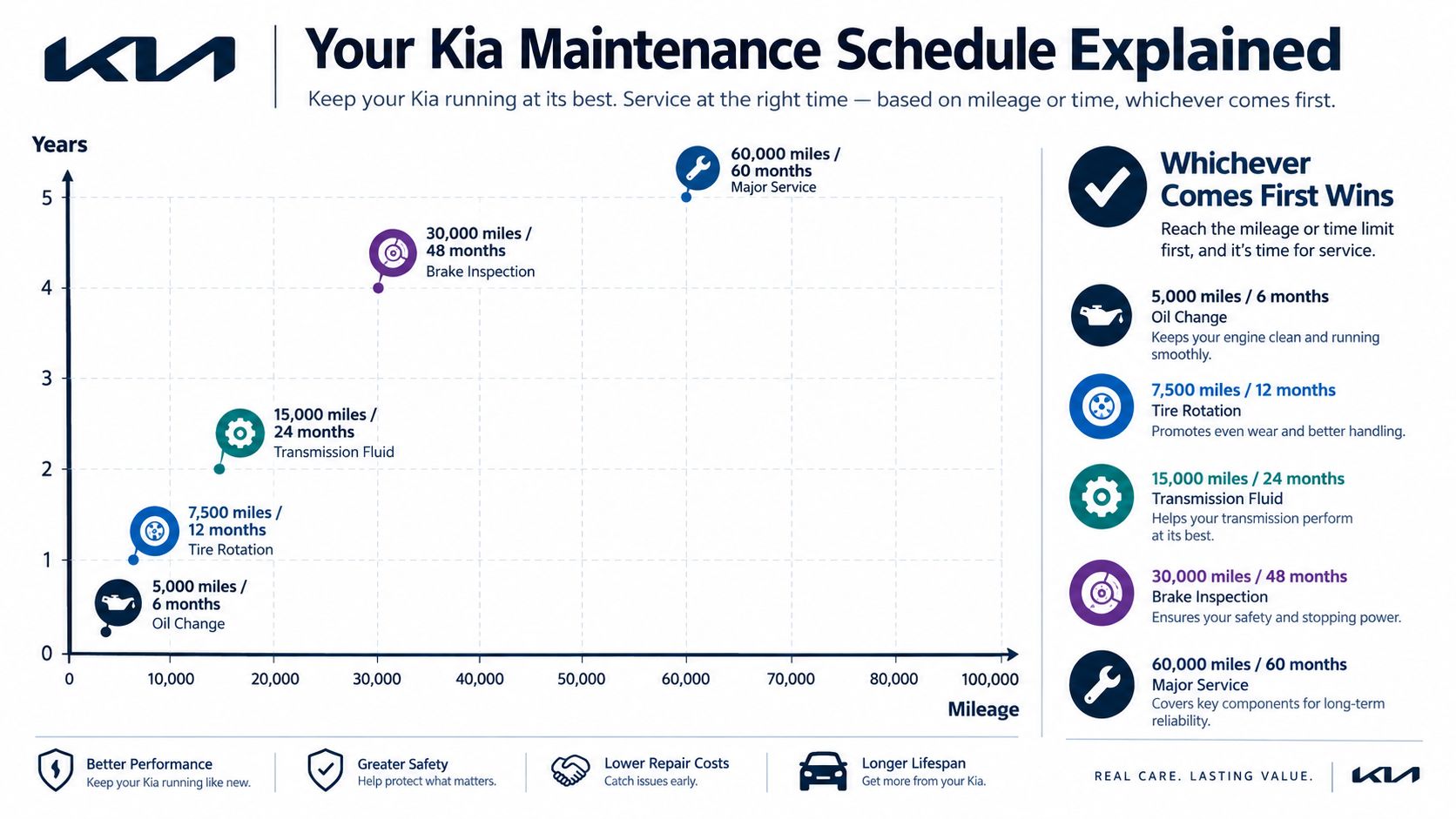
Kia maintenance runs on two clocks, mileage and time. Whichever threshold arrives first controls the appointment. A vehicle that accumulates miles slowly still needs calendar-based care, while a high-mileage commuter may reach the mileage requirement long before the year is over.
For Kia Gas Efficient Vehicles, Kia’s published schedule provides a useful framework for models such as the Sportage, Sorento, and Seltos. The schedule lists tire rotation at 8,000 miles or 12 months, then repeats it at 16,000-mile intervals. Engine oil and filter service is also listed at those intervals. At 24,000 miles, the engine air-cleaner filter is added, and brake-fluid replacement appears at 40,000 miles, according to Kia’s published vehicle maintenance information.
Match the schedule to your driving
A Seltos driver making short trips around Queens may reach 12 months before 8,000 miles. That doesn’t mean the service can be skipped. Time affects fluids, rubber components, batteries, and other parts even when the odometer moves slowly.
A Sorento family that makes frequent Long Island trips may reach the mileage threshold first. The same rule applies to a Sportage commuter crossing bridges and highways throughout the week. Record the date and mileage at every visit, then set the next reminder using whichever limit comes sooner.
Use the owner’s manual and the vehicle-specific Kia schedule for exact requirements. Treat the published intervals as the baseline, then tell the advisor how you drive. Frequent pothole impacts, heavy cargo, repeated short trips, and long periods of curbside parking can make an inspection more valuable even when a replacement isn’t yet due.
The schedule is a planning tool, not permission to ignore symptoms. A vibration, warning light, fluid leak, pulling steering, or grinding brake sound deserves attention before the next routine appointment.
The schedule’s timeline should guide your calendar, while your vehicle’s condition determines what requires diagnosis today.
Essential Services Every Kia Needs
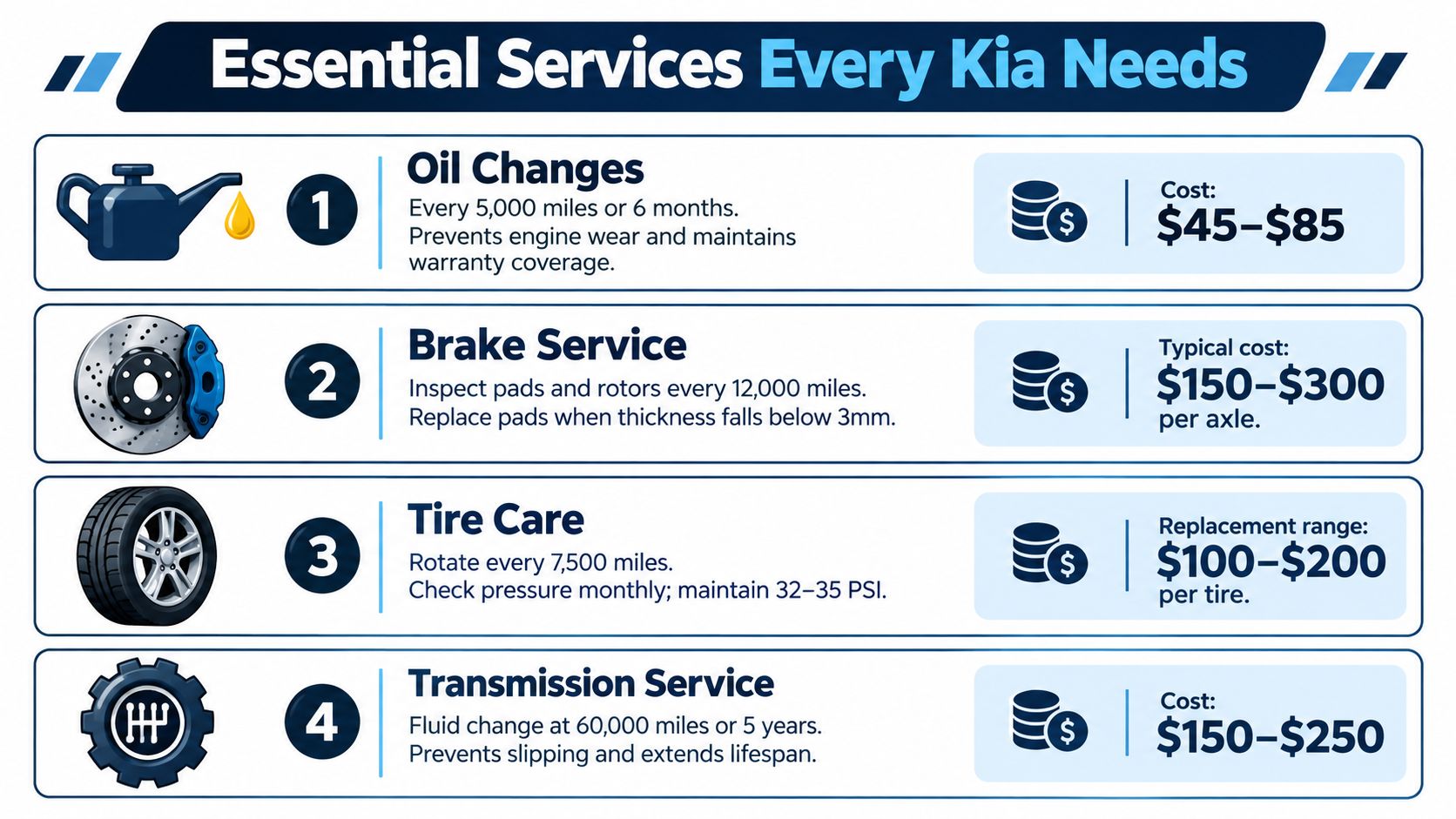
A maintenance schedule is useful only when you understand the work behind each line. Oil, brakes, tires, and transmission service protect different systems, and NYC driving puts distinct pressure on each one.
Oil changes protect the engine’s working parts
An oil and filter service removes used oil, installs the correct replacement filter, checks fluid levels, and gives the technician an opportunity to spot leaks or related concerns. The key isn’t loyalty to a particular oil-change brand. It’s consistent service using the correct specification for your Kia and recording when the work was completed.
Short urban trips, idling, and repeated cold starts can make a neglected schedule especially unwise. Don’t stretch service because the vehicle still feels normal. Engines can continue running while oil quality and filtration decline.
Takeaway: Follow the mileage-and-time schedule, and keep the invoice showing the oil, filter, mileage, and date.
Brake service starts with symptoms and inspection
Stop-and-go traffic means frequent braking, and heavy passenger loads can increase the work your brake system performs. Listen for grinding or persistent squealing. Pay attention to vibration through the steering wheel, a soft or sinking pedal, pulling during braking, or a warning light.
A brake inspection should distinguish between brake pads, rotors, calipers, hardware, and related components. Replacing one worn part without checking the rest can leave the underlying problem unresolved.
Brake advice: A noise is a reason to inspect the system, not a reason to wait for the noise to become louder.
Takeaway: Approve brake work based on measured condition and safety, not a vague recommendation.
Tires need more than a quick glance
The National Highway Traffic Safety Administration identifies correct inflation as the most important tire-maintenance practice because pressure affects durability, fuel consumption, steering, traction, braking, and load-carrying capacity. Underinflation increases flexing and heat, while overinflation reduces impact tolerance.
Measure every tire, including the spare, at least monthly when cold. A cold tire has been stationary for roughly three hours. Use the pressure listed on the driver-door placard or in the owner’s manual, not the maximum pressure molded into the tire.
Inspect tread wear, cracks, embedded objects, and sidewall damage after pothole or curb impacts. Rotation helps manage wear, but it won’t correct an alignment or suspension problem.
Takeaway: Check pressure monthly, inspect after impacts, and ask for tread and sidewall findings in writing.
Transmission service is easy to forget
Transmission work often disappears from a driver’s attention because the vehicle may shift normally for years. That’s exactly why fluid condition and scheduled inspection matter. A transmission service can involve fluid replacement, leak checks, diagnostic review, and inspection of related components according to the vehicle’s requirements.
Hard shifts, delayed engagement, slipping, unusual noises, or fluid leaks need diagnosis rather than a guess. Don’t approve a major repair based only on a symptom description. Ask what the technician found, what test confirmed it, and what happens if the work is deferred.
Takeaway: Ask for transmission fluid requirements and condition findings before a problem becomes a breakdown.
Why OEM Parts Make a Difference
OEM means original equipment manufacturer. For a Kia, an OEM part is designed to match the vehicle’s intended specifications, fit, and system requirements. That matters when the part affects braking, electrical power, sensors, fluid control, or the interface between several components.
A genuine Kia brake rotor for a Sportage or K5 is selected for that vehicle’s application. A Kia battery is matched to the vehicle’s electrical demands. Oil filters, transmission-service parts, tires, brakes, batteries, and accessories all deserve the same question: does this part fit the vehicle correctly, and can the installer stand behind the application?
Aftermarket parts aren’t automatically bad. Some are perfectly serviceable, and their lower upfront price can make sense in certain situations. The problem is treating every cheaper part as an equal substitute without checking fit, material quality, warranty terms, or expected service life.
The cheapest part is rarely the cheapest outcome if it creates repeat labor, inconsistent performance, or an avoidable second repair.
OEM parts also simplify documentation. A future buyer, warranty administrator, or service advisor can more easily understand what was installed and why. That record supports consistent performance and can help protect the vehicle’s maintenance history.
Ask what the estimate actually specifies
Don’t accept “brakes” or “battery” as a complete parts description. Ask whether the estimate identifies the part, warranty, labor, and any related hardware. For a tire, ask about size, load rating, speed rating, tread condition, and whether the vehicle needs alignment work after an impact.
Use OEM parts where the component’s fit and system compatibility matter most. If you choose an aftermarket alternative, make that a documented decision based on specifications and warranty, not an automatic price race.
Understanding Service Costs and Estimates
Many drivers assume dealership service always costs more. Recent survey data challenges that assumption. Cox Automotive’s 2025 Service Industry Study reported average 2025 spending of $261 at dealerships versus $275 at general repair shops. The same study found that 45% of owners remained dissatisfied with dealership service, with unexpected costs and poor communication identified as major reasons. It also reported that 55% consider online cost comparison very important, while 13% cited difficulty finding prices and 12% said the final bill exceeded the estimate.
The lesson isn’t that every dealership is inexpensive or every independent shop is costly. The lesson is that transparent pricing builds more trust than a low headline price.
Read the estimate line by line
A clear estimate should separate the work so you can make an informed decision.
- Diagnostic fees: Ask what testing is included, whether the fee applies to approved repairs, and what finding produced the recommendation.
- Labor: Check the labor operation, estimated time, and whether diagnostic labor is separate from repair labor.
- Parts: Confirm the part description, quantity, brand or OEM status, and warranty.
- Taxes and shop charges: Ask whether disposal, supplies, or other charges appear separately.
- Required versus recommended: Required work addresses safety, operation, recall, or a documented maintenance need. Recommended work may be condition-based or preventive. The advisor should label the difference.
- Warranty coverage: Ask whether the vehicle, part, or repair qualifies for warranty coverage before approving paid work.
Compare the service process, not just the total
| Factor | Dealership Service | Independent Shop |
|---|---|---|
| Vehicle information | Kia-specific service history and manufacturer procedures may be available | Depends on the shop’s records and access to vehicle information |
| Parts choice | OEM parts and Kia-specific ordering are available | OEM and aftermarket choices may be offered |
| Diagnosis | Kia-focused tools and procedures | Capability varies by technician and equipment |
| Estimate clarity | Should identify labor, parts, taxes, and approval points | Should provide the same breakdown before work begins |
| Warranty questions | Can review Kia-related coverage and recall status | May need to coordinate with the manufacturer or another repair source |
| Convenience | Online appointment tools and scheduled service workflow | Varies by location and operating hours |
Never authorize an open-ended repair. Set a written approval limit and require a call before the shop exceeds it or discovers additional work. Approve a repair when the diagnosis is clear, the vehicle remains useful, and the cost supports continued ownership. Defer noncritical work when the technician documents that the vehicle is safe to operate and gives you a specific follow-up window.
Consider replacement when repair costs, remaining vehicle life, safety, and financing no longer make continued ownership sensible. That decision should be based on the full ownership picture, not the emotional shock of one estimate.
Maintenance for Hybrid and Electric Kia Models
EVs and hybrids need a different maintenance strategy, not zero maintenance. The U.S. Department of Energy notes that battery-electric vehicles generally have fewer moving parts and lower operating and maintenance costs than conventional vehicles. An NBER review cited in the same verified information reports that a DOE federal-fleet study estimated ongoing maintenance costs for fully electric powertrains at roughly 60% of those for vehicles relying fully or partially on combustion engines.
The reduction comes largely from eliminating engine-specific work such as oil and filter changes, spark-plug replacement, exhaust-system service, and many transmission-related operations. Regenerative braking can also reduce friction-brake wear by converting part of the vehicle’s kinetic energy into electrical energy.
That doesn’t mean you can ignore the brake system. Pads, rotors, calipers, brake fluid, and electronic controls still need inspection. The vehicle must slow safely whether it uses friction braking, regeneration, or both.

What remains on the service list
Tires deserve special attention. EVs can be heavy and deliver immediate torque, which can increase tire wear. The Aftermarket Matters report on EV service found that 25% of general shops do not work on EVs, while 70% report that EVs represent 10% or less of their annual vehicle volume. Among shops servicing fully electric vehicles, tire maintenance was the most common service, cited by 65%.
For Queens drivers, curbside parking, potholes, winter temperatures, and stop-and-go traffic make the remaining inspections practical priorities:
- Tires: Check pressure, tread, sidewalls, and alignment after impacts.
- Steering and suspension: Inspect components affected by potholes and curb strikes.
- Thermal systems: Check coolant or thermal-management circuits where applicable.
- High-voltage equipment: Inspect cables and related components using manufacturer-specific safety procedures.
- Charging equipment: Investigate damaged connectors, charging interruptions, or warning messages.
- Software and diagnostics: Scan persistent warnings instead of resetting them and hoping they disappear.
- Battery condition: Review available diagnostic information and follow the vehicle’s service requirements.
High-voltage service isn’t a generic repair task. It requires trained technicians, proper isolation procedures, and manufacturer-specific diagnostic equipment. Choose a service department that can document what it inspected and why.
How Northstar Kia Simplifies Service in NYC
Northstar Kia operates on Northern Blvd in Woodside, Queens, serving Brooklyn, the Bronx, Long Island, and greater New York City. Its online service scheduling and appointment-request tools reduce phone tag, which matters when your workday doesn’t leave room for repeated calls.
The dealership lists extended service and parts hours for urban schedules. Its on-site Parts Center supports OEM parts ordering, tires, brakes, batteries, oil changes, transmission services, and accessories. Service specials can also help reduce the cost of routine work, so check the available offer before approving a larger maintenance visit.
Spanish-language support is available for customers who prefer it. That matters when a technician’s findings, estimate, and approval limits need to be understood clearly before work begins.
Check recalls by VIN
Recall service is part of safe ownership, not an optional upgrade. NHTSA reported a recall affecting certain 2023–2025 Telluride vehicles because exterior door-belt molding could detach and become a road hazard. The remedy called for dealer inspection and replacement of affected assemblies at no charge. Owners can verify open recalls through NHTSA’s VIN recall lookup.
Bring the VIN and the vehicle’s service history to the appointment. Online scheduling helps with limited time, extended hours reduce conflicts with work, and parts availability can reduce delays. Those details address the NYC costs of maintenance, parking, travel time, and vehicle downtime.

Building Your Year-Round Maintenance Routine
Put tire pressure on a monthly reminder. Check every tire when cold, including the spare, and use the driver-door placard or owner’s manual specification. Repeat the inspection after a pothole or curb impact.
Tie your calendar to the 8,000-mile or 12-month oil and tire-rotation interval for Kia Gas Efficient Vehicles, using whichever arrives first. Before winter, ask for a battery and tire inspection because seasonal temperature changes can expose weak batteries, low pressure, and existing tread or sidewall damage.
When a recall notice arrives, verify it by VIN rather than assuming it applies or doesn’t apply. Schedule around available service hours, review service specials before major work, and keep every written estimate and invoice.
A maintained K4, Seltos, Sportage, Sorento, K5, or Telluride is better prepared for city streets, family trips, and daily commuting. It stays safer, wastes less fuel, and gives you a clearer ownership budget.
Northstar Kia provides online service scheduling, Kia-focused maintenance, OEM parts, tire and brake work, recall assistance, and written estimates for Queens and greater NYC drivers. Review your Kia’s mileage and service history, then visit Northstar Kia to request an appointment before the next warning light makes the decision for you.
0 comment(s) so far on Kia Service and Maintenance Guide for NYC Owners