
New Kia K4 Guide: Specs, Trims, and Real-World Value
If you’re staring at a worn-out sedan and trying to decide whether your next car should survive the BQE, school drop-offs, and curbside parking in Queens without blowing up your budget, the new Kia K4 deserves a real look. It’s the kind of compact sedan that makes sense for a Woodside commuter who wants modern tech, a calmer cabin, and enough room to stop feeling squeezed every time a stroller, backpack, or grocery run enters the picture.
What’s changed is the way shoppers are thinking. The old habit was to cross-shop the usual compact names first, then settle for whatever lease or inventory happened to be available. The K4 changes that because it gives practical buyers a larger footprint, two clear engine choices, and the kind of safety and comfort mix that makes daily use easier rather than just flashier.
Table of Contents
- Why the Kia K4 Is Suddenly on Every Commuter’s Shortlist
- Kia K4 Core Specs and Platform
- The K4 Trim Lineup from LX Up to GT-Line Turbo
- How the Two Engines Feel in City Traffic
- Safety Tech, Interior Features, and Daily Comfort
- Should You Buy a Gas K4 Now or Wait for Electrification
- Choosing the Right K4 at Northstar Kia in Woodside
Why the Kia K4 Is Suddenly on Every Commuter’s Shortlist
A lot of buyers don’t start with a dream car, they start with a traffic problem. A Woodside commuter stuck behind brake lights on the BQE wants a sedan that feels easy to live with, fits in tight street parking, and doesn’t make every merge feel like a negotiation. That’s where the Kia K4 has moved from “interesting new model” to a real contender for 2026 shoppers.
The K4 replaces the Forte, but it doesn’t feel like a simple rename. Kia gave it a bigger, more planted shape, a quieter cabin feel, and a design that looks more expensive than a basic commuter car usually does. Its U.S. dimensions tell the story clearly, with a 107.1-inch wheelbase, 185.4-inch overall length, 72.8-inch width, and 55.9-inch height in U.S.-market specifications, which puts it near the upper end of the compact class for space and presence Kia U.S. K4 specs and dimensions.
That matters in New York because compact sedans live or die by daily livability, not just badge recognition. A car that feels slightly roomier on the inside can make a long commute less tiring, and a wider footprint can help the car feel more settled on rough roads without pushing it into midsize territory. The K4’s shape also fits a buyer who wants a sedan instead of an SUV, because it keeps the driving position lower and the body easier to place in traffic.
Practical rule: if your car spends more time on city streets than in a suburban driveway, comfort and visibility matter more than flashy spec-sheet bragging rights.
The K4 also benefits from timing. Many shoppers who’d normally compare Civic or Corolla trims are running into tighter availability, less flexible pricing, or just too much waiting around. Kia’s newer compact sedan gives those buyers a straightforward alternative, one that feels designed for people who need a car now, not eventually.
Kia K4 Core Specs and Platform
The easiest way to understand the K4 is to stop reading it like a trim checklist and start with what it is: a compact sedan built on a global architecture, not a one-off body shell for a single market. Kia’s U.S. specifications show the same basic footprint across the lineup, which means the car keeps its proportions and road feel consistent as you move through the trims Kia U.S. K4 specs and dimensions. For a first-time shopper, that consistency makes the K4 easier to judge. You are not learning a new car every time the badge changes.
In Queens traffic, that shape has a practical side. The 185.4-inch body still fits city streets without feeling oversized, while the 107.1-inch wheelbase helps explain why the cabin feels more generous than many compact sedans. The 72.8-inch width gives the car a settled stance, and the 5.3-inch ground clearance is enough for normal urban driving without turning the sedan into a crossover Car and Driver K4 overview.
What the two engines really mean
Kia gives the K4 two different powertrain choices, and they serve different kinds of drivers. The standard setup is a 2.0-liter inline-4 with 147 hp and 132 lb-ft, paired with a continuously variable transmission. The GT-Line Turbo uses a 1.6-liter turbocharged inline-4 with 190 hp and 195 lb-ft, matched with an 8-speed automatic and front-wheel drive Car and Driver K4 overview.
That split matters because the numbers point to two different commuting experiences. The base engine is the calmer choice for stop-and-go driving, where smoothness matters more than quick bursts. The turbo model is the one that should feel more ready when you are merging into fast traffic, passing on a short opening, or carrying extra passengers.
| Kia K4 Core Specifications at a Glance | K4 (2.0L) | K4 (1.6L Turbo) |
|---|---|---|
| Engine | 2.0-liter inline-4 | 1.6-liter turbocharged inline-4 |
| Horsepower | 147 hp | 190 hp |
| Torque | 132 lb-ft | 195 lb-ft |
| Transmission | Continuously variable transmission | 8-speed automatic |
| Drivetrain | Front-wheel drive | Front-wheel drive |
| Rear legroom | more than many compact sedans | more than many compact sedans |
| Cargo volume | sedan trunk capacity | sedan trunk capacity |
| Fuel tank size | standard fuel tank | standard fuel tank |
Kia also highlights the turbo model’s 12-inch ventilated front brakes in its own material Kia U.S. K4 material. That tells you the stronger version is not only about acceleration. It is built for repeated stopping, which matters in New York traffic where the car spends as much time braking as it does moving.
The K4 Trim Lineup from LX Up to GT-Line Turbo
Trim shopping gets confusing fast because buyers often focus on one feature and ignore the rest. In the K4, the smarter way is to match each trim to a real use case, then stop when the car already fits the way you drive. If you commute mostly solo, you don’t need to pay for every sporty visual upgrade. If you’re hauling kids or passengers, comfort and ease-of-use matter more than badge drama.
Which trim fits which driver
The LX is the basic starting point, and that’s exactly how a lot of New York buyers should treat it. It makes sense for someone who mainly wants a new sedan with modern safety tech and a lower entry point. The LXS usually appeals to commuters who want a few more convenience touches without stepping into a sportier image.
The EX is the trim where the K4 starts to feel more relaxed for everyday ownership. It’s the version many shoppers should examine if they care about creature comforts, daily livability, and a cabin that feels less stripped down. The GT-Line is the visual and chassis-leaning choice for drivers who want the more assertive look without necessarily jumping all the way to the turbo powertrain.
The GT-Line Turbo is the most obvious answer for shoppers who know they’ll notice sluggish response. It pairs the stronger 1.6-liter turbo with the 8-speed automatic, and Kia’s own U.S. material also points to the bigger front brakes on this model Kia U.S. K4 material. That makes it the trim to prioritize if your routine includes fast merges, loaded passenger runs, or frequent highway driving.
| Kia K4 Trim Comparison | Engine | Key Features | Best For |
|---|---|---|---|
| LX | 2.0L | Entry-level K4 setup, practical equipment | Budget-focused commuters |
| LXS | 2.0L | Adds more convenience and everyday usability | City drivers who want value with a few extras |
| EX | 2.0L | More comfort-oriented feel | Small families and long daily drives |
| GT-Line | 2.0L | Sport styling and a more visual personality | Buyers who want a sharper look without turbo cost |
| GT-Line Turbo | 1.6L Turbo | 190 hp, 195 lb-ft, 8-speed automatic, 12-inch ventilated front brakes | Drivers who want stronger passing and merge confidence |
A useful shortcut is this. If you care most about price and simple ownership, start low. If you care most about acceleration feel and better response in traffic, skip straight to the turbo discussion.
How the Two Engines Feel in City Traffic
The engine choice looks simple on paper, but New York traffic makes the difference easy to feel. A commuter car has to pull away cleanly when the light changes, slip into a gap without drama, and stay calm when the lane ahead keeps stopping and starting.
The base 2.0-liter in daily use
The 2.0-liter with the CVT is the calmer pick. It should suit routine commuting, steady traffic, and buyers who care more about smoothness than urgency. If your day is mostly Queens side streets, short hops, stop-and-go traffic, or carrying one or two passengers without heavy loads, the base engine fits that use case well.
Where it can feel less satisfying is in the moments that ask for quicker response. That matters most when you try to join faster traffic or pull into a tight opening. Reviewers have also pointed out that the less responsive automatic behavior on some K4-family versions can take some of the polish out of everyday driving, which is why the engine choice matters so much in practice evo review of the Kia K4.
The 1.6-liter turbo when traffic opens up
The 1.6-liter turbo gives the car a different character. With 195 lb-ft arriving around 1,700 rpm, it should feel stronger in the low-speed, high-demand moments that define city driving Car and Driver K4 overview. That helps on fast merges, in short bursts into traffic, and any time you want the car to move with less hesitation.
In New York traffic, torque often matters more than peak horsepower because the hard part is getting moving cleanly, not chasing top-speed numbers.
The trade-off is straightforward. The turbo setup should feel more confident, but it is also the version that makes the engine decision harder to ignore. If you do not regularly need that extra shove, the base engine can still make sense as the simpler companion for daily commuting.
| 2.0L vs 1.6L Turbo in Real City Conditions | 2.0L Naturally Aspirated | 1.6L Turbo |
|---|---|---|
| Green-light takeoff | Smooth, calmer, more gradual | Quicker and more immediate |
| Fast merge onto the BQE | Adequate if you plan ahead | Better when gaps open suddenly |
| Stop-and-go traffic | Easygoing and relaxed | Feels less strained under demand |
| Highway passing | Fine for patient drivers | More confident for quick passes |
| Overall personality | Simple commuter focus | Stronger, more responsive feel |
For buyers who keep asking whether the smaller engine always saves a lot more fuel, the answer is usually no. In UK testing, The Car Expert measured 43 mpg against Kia’s official combined figure, while a separate route returned 42 mpg from the more powerful 147 bhp version, which shows that real-world economy does not always track engine size The Car Expert road test.
Safety Tech, Interior Features, and Daily Comfort
A commuter usually feels safety in the little moments, merging into traffic, changing lanes, or backing out of a tight curb space. The Kia K4 is built with that kind of daily use in mind. Latin NCAP reported five-star results for the Kia K4 sedan and hatchback produced in Mexico, with 91.87% Adult Occupant protection, 90.38% Child Occupant protection, 77.10% Pedestrian Protection and Vulnerable Road Users, and 84.30% Safety Assist, plus standard 6 airbags and Electronic Stability Control Latin NCAP results for the Kia K4. ANCAP also published strong results for the K4, including 85% Adult Occupant Protection and 80% Child Occupant Protection in one configuration, which is another sign that the car is being treated seriously in global compact-sedan testing ANCAP K4 rating.
What the tech does for different drivers
For a commuter, the useful features are the ones that cut down on small stresses, not the ones that look flashy on a spec sheet. Forward Collision Avoidance, Lane Keep Assist, Blind-Spot Detection, and Highway Driving Assist help with the constant corrections and alerts that can wear you out over a long week. In that sense, the system works like an extra set of eyes that keeps watch during rush hour.
For a gig driver, the cabin needs to stay organized. Wireless connectivity, a clear screen layout, and charging access help keep navigation, pickup apps, and music from competing for attention. For a small family, the question changes again, because rear-seat room and easy child-seat use matter more than sporty trim details.
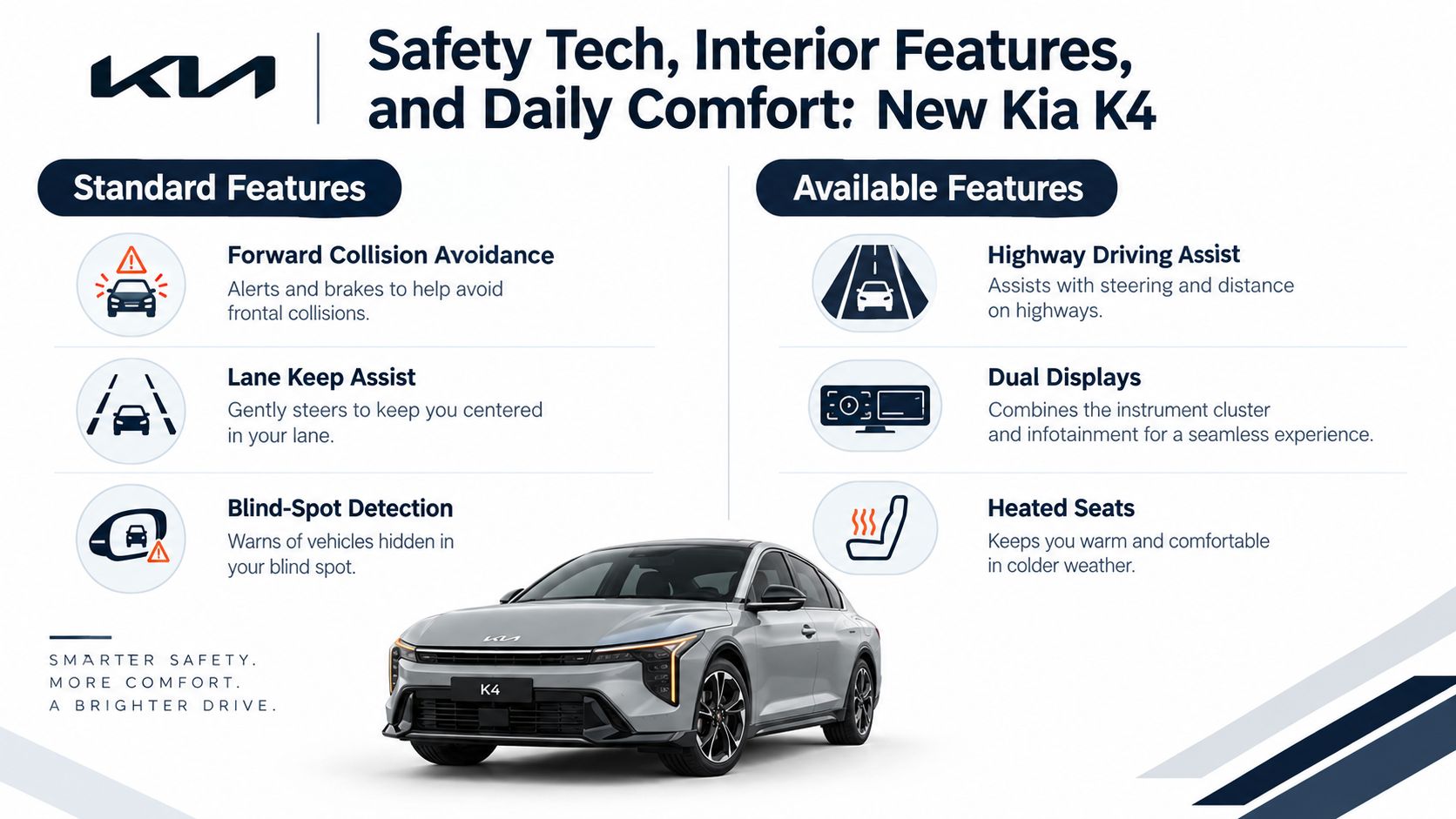
The cabin aims for a modern feel without becoming busy. Kia’s current K4 material emphasizes a dual-display layout, and the model is set up with the connected features shoppers now expect in this class. A good dealer walkthrough should show how the touchscreen, phone integration, and seat comfort work together, because that is what shapes the daily experience more than the badge on the trunk.
Practical rule: if you will spend an hour a day in the car, choose the trim that lowers stress first, then decide how much style you want.
Should You Buy a Gas K4 Now or Wait for Electrification
A lot of shoppers hear “new model” and start wondering if they should wait for a hybrid or plug-in version. That question is reasonable, but it does not always fit a New York buyer who needs a car now. Recent coverage says hybrid or plug-in hybrid versions still are not available in key markets, and the mild-hybrid setup can reduce boot capacity, which matters if you want a trunk that stays useful for groceries, strollers, or work gear The Car Expert road test.
The stronger argument for the gasoline K4 is certainty. You can buy the car that exists today, judge the engine in person, and avoid waiting on rollout timing that may not match your own schedule. For a commuter in Queens, that can matter more than chasing the idea of a future version.
Registration, insurance, and parking costs also belong in the decision. A gas K4 may be the simpler choice if you want a familiar ownership pattern and a payment plan you can estimate without adding charging equipment or changing your routine. A hybrid can make sense later, but only if the numbers and your living setup line up.
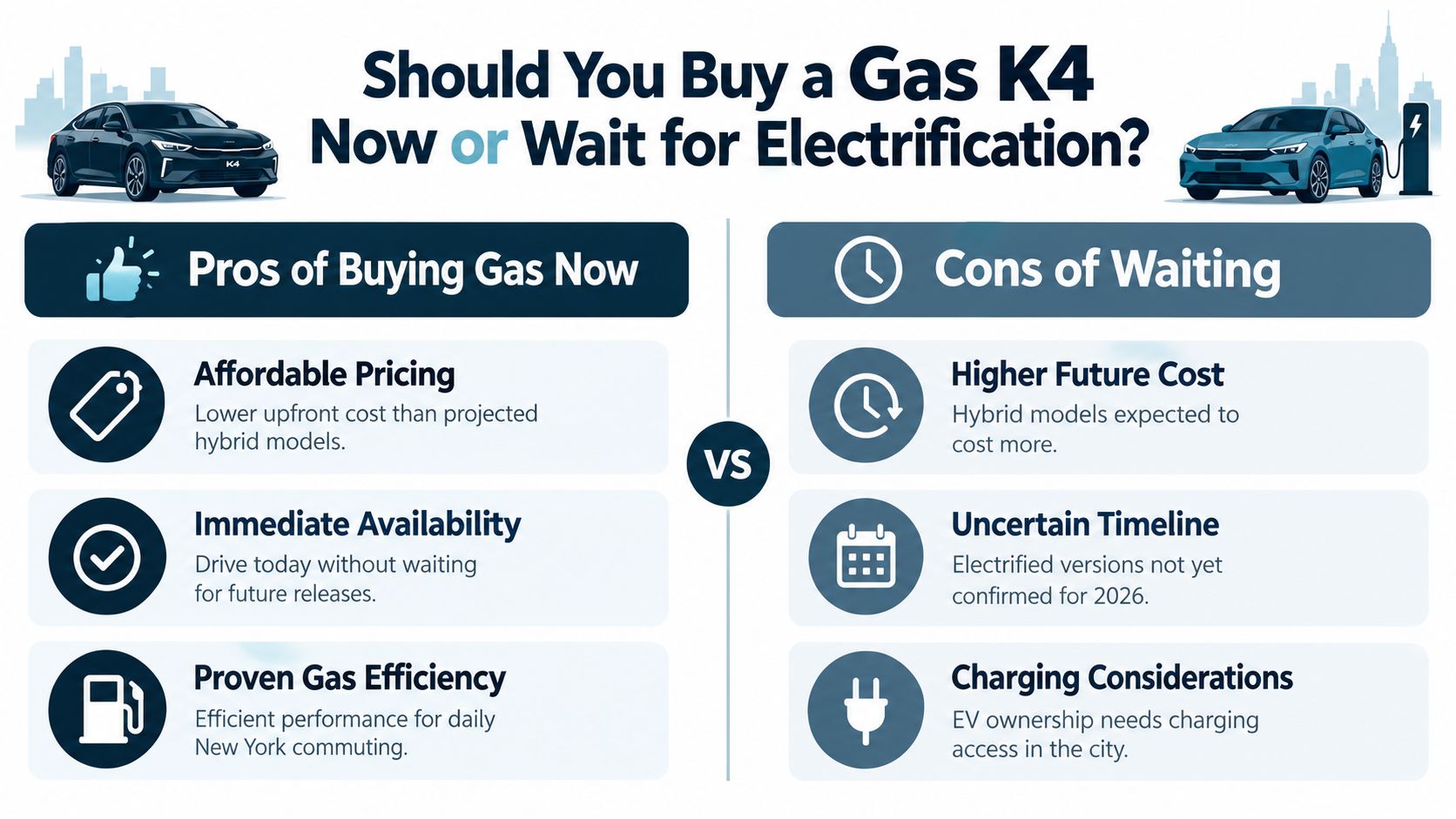
That is why the comparison is not “old tech versus new tech.” It is “known fit now” versus “possible fit later.” Kia’s global sales reached a record in 2025, and the company set 2026 targets, so the nameplate has room to grow rather than look like a short-lived experiment Kia Newsroom. But a stronger future for the badge does not solve a commuter’s immediate need for transportation.
For most shoppers, the safest rule is simple. Buy the gas K4 now if you need predictable availability, a clear ownership cost, and a car you can register and drive without waiting. Hold off only if you already know electrification is part of your plan and you can afford to wait for the right version, not just any version.
Choosing the Right K4 at Northstar Kia in Woodside
The easiest shopping mistake is showing up without a plan and trying to sort trims from memory in the parking lot. Start by narrowing your use case before you visit. If you’re a daily commuter, aim for the trims that keep the car simple and comfortable. If you drive rideshare or delivery shifts, focus on responsiveness and phone connectivity. If you’ve got a small family, pay attention to rear-seat access, comfort, and whether the cabin feels easy to load and unload.
Before the test drive, bring your license, insurance information, and trade-in details. If you have a current car, be ready to talk openly about what you owe, what you still like about it, and what made you start shopping now. That gives the sales team a real starting point instead of a guessing game.
What to test on Woodside roads
A good drive route should include the kinds of roads you’ll use. Around Woodside and wider Queens, that means slow turns, abrupt lane changes, short merges, and a stretch where the car can settle down at speed. The base engine should feel calm and predictable, while the turbo should answer more quickly when you press the pedal.
Ask the product specialist to show you the trim differences side by side instead of listing them from memory. Compare the LX, LXS, EX, and GT-Line Turbo with your own routine in mind, not with someone else’s. If you mainly care about budget, don’t let sport styling talk you into a payment you won’t enjoy.
Northstar Kia in Woodside is one option for that kind of comparison shopping because it lists new K4 inventory, research tools, finance help, and service support on its site. That can make it easier to move from online narrowing to an actual drive without having to bounce between multiple stores.
The right K4 feels obvious when your test route matches your commute.
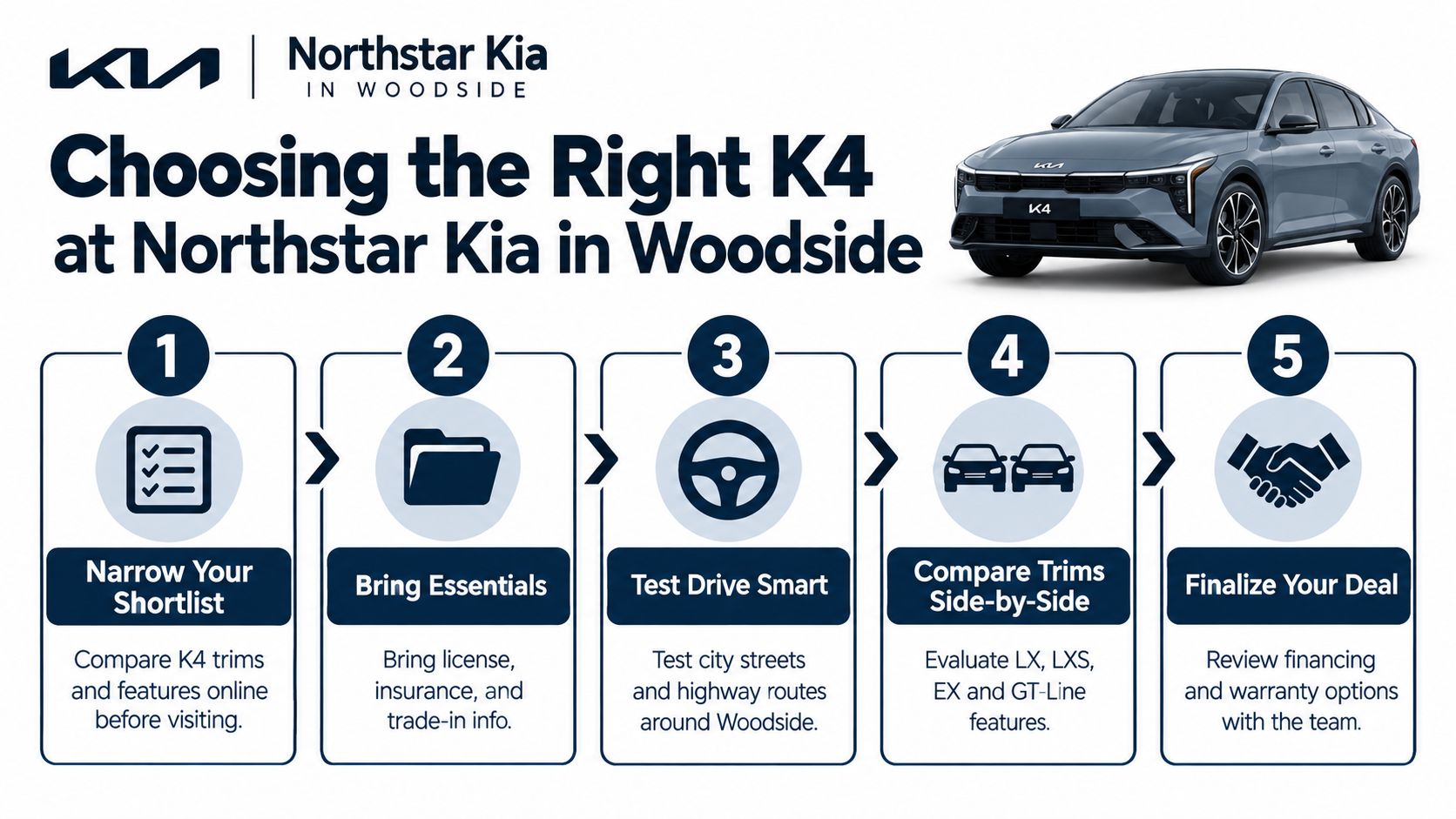
For many NYC buyers, the final checklist is short. Pick the trim that matches your real route, ask about financing before you decide, and check delivery timing against your current car’s condition. If the K4 answers your daily needs without pushing you into features you won’t use, you’ve probably found the right one.
If you want to compare K4 trims, talk through trade-in details, and see which version fits your Queens commute, visit Northstar Kia and look at the current K4 inventory before you make the trip to Woodside. A focused visit can save you time, and the right trim discussion can make the decision much easier than sorting it out after you’ve already spent an afternoon in traffic.

0 comment(s) so far on New Kia K4 Guide: Specs, Trims, and Real-World Value